Working magic with greens


Book review, from Toronto to Tokyo – The Fan Brothers’ first picture book collaboration, The Night Gardener, vividly captures a transformation — from bland, dreary outlook to bristling, colourful reality.

On the cover of the multi-award winning book stands an intricately sculpted owl in the light of the moon. A young boy looks up, mesmerized by the creation. This boy is William, and he lives with other children in Grimloch Lane, a street in lined with very ordinary trees and buildings. As dreary as the location sounds, the book starts off with William’s gaze fixated on something outside. The next moment, he is there, outside, staring from a distance in awe at the wise owl that was once just another boring tree. It had appeared out of nowhere in the night.

Every beautifully crafted tree draws William out, along with others in the town. Green makes room for colour, and inertia for momentum. William soon stands among the people living there, who had also come to see the masterpieces. He later finds the gardener who worked his magic in the night, but the stranger leaves, leaving no physical trace of his visit as his creations fall away through the seasons. But by the end, the town comes alive, with an ice cream truck that asks people to “watch for children” as they play outside. William had changed too, snipping away at a bush in the moonlight under a squirrel’s watchful eye.

The pictures in the book contains clues to William’s story. A photo beside him as he looked out the window suggests that he had known his parents. The elusive gardener’s 2-page dragon masterpiece was not the terrifying, fire-breathing kind, but a slender, graceful one that seemed as ready to soar the skies as it were to glide through the oceans. As the skies darkened, oriental laterns would join the dragon in adorning a local festival. The ideas in these pictures piece together a story beyond change, of using art to reach out to bring people together, and most importantly, of watching over every child and helping them find their dreams.

Title: The Night Gardener
by The Fan Brothers (Eric Fan and Terry Fan)
Publisher: Simon & Schuster Books for Young Readers, 2016
Available in hardcover and Enhanced eBook
Carrying on from a story of March 11


Book review, from Tokyo – Leza Lowitz’s verse novel Up From the Sea tells the story of Kai, a teenage boy who survives being swept away by the tsunami.

In just a few opening pages, we are given a quick rundown on his Japanese family, his estranged American Dad in New York, his pals Ryu and Shin, and his daily routine. And when the earthquake struck, everything came, thick and fast. We race out of school together with him and through his town in search of higher ground, but get swept under. He and his classmates, Taro, best friend Shin, and Keiko survive, and are later reunited with Ryu. We later learn that he loses his grandmother, and finds his grandfather’s shattered fishing boat, but not his mother.

Fighting and spite with Taro seem to give respite from guilt, loneliness, confusion, and anger. Then there are the calm, heartening moments. These seem to grow as Kai begins reaching out to other survivors, bringing food to people, handing out riceballs, kicking a soggy football with Guts and other younger boys, praying for the dead.

But his mental state remained still fragile. Come summer, the Japanese tradition of making wishes on Tanabata (七夕, Chinese Qixi festival) reminded of his childhood dreams and wishes, and his encounter with a drunk buried in the sand ends with him wandering into the sea. He is saved, and realizes something that gives him newfound hope.

Surviving yet again, a talk with his grandfather’s fisherman friend Old Man Sato gives him some wise old words that help him take the chance to meet 9/11 orphans. He finds his way to the US, and perhaps his father, and returns alone to Japan after leaving a note in New York. The novel ends on a tone of hope, of acceptance, of reconciliation with his father, and light shining the way forward.

I particularly liked how the novel threw me into the struggle right from the start and how the first person verse narrative effortlessly raced through the speaker’s emotions, and left me with work to do on some of Kai’s closest thoughts. Of the many moments that left an impression, the lessons from Old Man Sato’s story stood out – You’ve got to be able to save yourself, because “we’ve got the future to build.” Indeed.

Title: Up From the Sea
by Leza Lowitz
Publisher:
Hardcover: Crown Books for Young Readers, 2016,
Paperback: Ember, 2017

Misuzu Kaneko’s poems resonate across times and cultures


Book review, from Tokyo – I can’t remember when I first read a children’s collection of Misuzu Kaneko’s poems. Roundish, cartoony figures, cats, dogs, flowers, and clouds left a lasting impression of cute, simple poetry about the nature of things. Take “Tsuchi to kusa” (literally dirt and grass) for example, a poem that reminded me of the drab, unseen mother of its many more appreciated embellishments – grass, bushes, trees, flowers, anything that sprung from it.

Then came news of Chin Music Press’s Are you an Echo?: The Lost Poetry of Misuzu Kaneko. Eager to see more of her work, I ventured to Amazon.com to get copies over to Japan quickly. Illustrated by Toshikado Hajiri, the book weaves a selection of the poet’s literary expressions into her life story. Hajiri’s vivid depictions of scenes of Japan in the 1900s are based on actual research, coupled with an on-site visit to Senzaki, where Kaneko lived, now part of Nagato city in Yamaguchi prefecture. Hajiri combines these scenes with Japan’s famed “five seasons”, which includes the rainy season ahead of summer, to immerse readers in Japanese sentiments of seasonal change.

The book covers her life, from her upbringing in a family bookstore to her breakthrough as a promising poet, and her marriage to a philandering husband. Kaneko would go on to end her life. Weakened by gonorrhea and having lost custody of her young daughter after her divorce, the pages covering her decision and determination for the child to be raised by her grand mother are accompanied by a poem “Cocoon and Grave” and a shining, fluttering butterfly breaking through the shadows.

Her poems then became lost alongside other literary works in the imperial propaganda and the outbreak of war. Her works were later found, another story in itself that is covered briefly at the start of the book. Those who were in Japan shortly after the 3.11 earthquake and tsunami might recall the TV commercials by AC Japan that followed. One of them used Kaneko’s poem, “Kodoma deshou ka”, translated into English as “Are you an Echo?” in the title of the book. Some thought this reminded people of others and the fact that everyone is in it together. To me, it remains one of my favourite, alongside “Tsuchi to kusa” (not in the book) mentioned earlier, and “Bird, Bell, and I”. By the time I had finished the book, I had a new perspective on her work.

The book wraps up its journey with a selection of 15 out of her 512 poems, each one unearthed from the sands of the time to ring across the ages. They have most certainly travelled across the seas, thanks to this publication, hopefully to be spoken about and read by many more.

Title: Are you an Echo?: The Lost Poetry of Misuzu Kaneko
Illustrated by Toshikado Hajiri (see more of his work here)
Narrative by David Jacobson
Translations and editorial contributions by Sally Ito and Michiko Tsuboi
Publisher: Seattle, Chin Music Press, 2016

(Ed. Added link to illustrator’s website, corrected poem title)

Parenting or not in Web 2.0


Book review, from Singapore to Tokyo – Pinch, drag, flick, tap. Slick moves mastered to deal with life to the tune of each new generation of smart devices. Buzz, flicker, ring, flash. An endless deluge of noise, light, vibes, and activity that demands our attention at every other moment, as if we did not have enough to deal with already.
Sometimes our devices bring new and refreshing updates, but more often just rejigged posts. At other times we’re creating something for everyone else in this age of user-generated content. And if you’ve got a kid craving for attention, then you’ll have trouble focusing on either. But we are in control, aren’t we? Or are we slaves of our own making?
Smart devices are so much a part of our lives today that misplacing one brings isolation from the connected world, the IoT. Well, in real life, we only have 24 hours a day to focus our limited energy on only so much. And if the touchscreen is taking our eyes off other things that should really matter, like your own kid, then obviously there lies a problem.

『ママのスマホになりたい』, “Mama no sumaho ni naritai” (literally, “I want to become mummy’s smartphone”) illustrates just this, drawing on a real essay by a Singaporean primary school boy, in which he professed that his wish was to become a smartphone (article at allsingaporestuff.com).

With Nobumi’s trademark cartoony characters, the simple, childishly spiteful exchanges between 3-year-old son and mother portrays the struggle for a parent-child relationship in an era of push feeds and other intermittent attention grabbers. The boy loses numerous creatively laid skirmishes, including a cardboard kingdom where smartphones are not allowed, before finally reconnecting with his mother.
A self-confessed guilty party, it is less my smartphone, but the daily struggle with the clock that leaves me wanting more play-and-bond time. Living with devices involves rules, balance, and understanding, something this book could maybe help parents and their children reach together. Then again with future generations set to bypass PCs and dive straight into mobile and wearable devices, and interacting through them, who knows whether this book be read the same way by the end of the next decade.
Kids grow up quickly, faster than the next app upgrade. We can uninstall updates on a whim but we can’t just reboot our lives, so I’ll be sure to catch myself on my smartphone at home, and my kids before they are ready to leave the roost!
Title: 『ママのスマホになりたい』 (Mama no sumaho ni naritai) by Nobumi
Publisher: Tokyo, WAVE Publishers, 2016

Questions from The Ranch of Hope


Book review, Tokyo – Years after the 3.11 triple disaster, a rancher continues to tend to his herd of more than 330 cattle in a no-go zone in Namie, Fukushima. Portrayed as a nuclear rebel by parts of the media, the picture book behind the ranch raises some serious questions.

On the cover of “Kibou no Bokujo” (The Ranch of Hope), he could easily have been chewing in defiance on a burning cigarette. Instead, it shows a man with his dog, cat, and cow with the ranch in the background.

The pictures go from animals and houses abandoned after the disaster to the lone rancher who stayed behind to tend to his ranch. Inside, cattle eat, drink, defecate, and get hungry. The rancher continues his job, feeding and tending to them. Some of the weaker grow ill and die, but the rest have remained healthy, eating, drinking, defecating, and getting hungry again. Cattle numbers have recovered, it says, as the ranch took in those that had wandered near from elsewhere.

The touching parting gaze between another rancher and his endearing calf is paired with a page splashed in red with carcasses and several men in the faraway background clad from head to toe in white protective wear. In contrast, the owner of the Ranch of Hope goes around doing his daily chores in his regular farming attire. He is simply doing his job, keeping his cattle fed and alive, even if they can no longer be sold because no one would take them.

The story goes deeper, into the rancher’s thoughts – what is the meaning of life, of plentiful rice fields, rivers teeming with fish, clean fresh air, a local brand painstakingly built up by the community over the years, that vanishes just like that?

The book’s sobering pictures serve as a reminder of the gravity of some decisions in life, which are made by a few and end up affecting many others.

Title: 『希望の牧場』 (Kibou no Bokujo, The Ranch of Hope)
text by Eto Mori, illustrated by Hisanori Yoshida
Publisher: Tokyo, Iwasaki Shoten, 2014

Summer past – Ninja special exhibit


Event, Tokyo – The Japanese summer didn’t stop my team from trekking almost 20 minutes under the scorching sun to Miraikan, National Museum of Science and Innovation, from Fune-no-kagaku-kan station on one fine, cloudless summer afternoon.

Besides the IDFes (short for idol festival) packed with adults, mostly men, lining up to jump and gyrate in unison at the performances of possibly the next big thing after AKB, families were resting outside the Miraikan, having some shaved ice doused in colourful syrup, soft-served ice cream, and whatever that was available cold just outside the cool indoor Ninja exhibition.

Some Pokemon event was also going on nearby, so the station was full of people going to or returning from some event. Giveaways of foldable cardboard Pokemon caps to kids provided scarce cover, while those handy fans offered some welcome breeze during our 20-minute trial of running from shade to shade. Telecom Center station would have been half the walk, but this journey warmed us right up for some Ninja training in the mild air-conditioning.

Once inside the exhibition hall, visitors became apprentices and were introduced to the various types of training that would ensure one left the hall trained as a “certified” ninja. From controlled breathing to stealth walking, jumping over a knee-high sunflower, throwing a rubber shuriken, differentiating smells, hearing for objects and information, and learning tidbits about nature, one would learn how to train mind and body, and be sensitive to changes in the environment.

The ninja, the eyes and ears of their masters, prevented unnecessary conflict and often gained priceless inside information. They were not merely masters of disguise, infiltration, and survival. Trained to hone their senses to identify the time of day, direction, tell the weather, see through a disguise, they made themselves very useful. Found across Japan during the feudal era, the Iga and Koga Ninja, in present day Mie prefecture, were the most well-known.

Not delving too deeply into any single aspect, trainees would pass the final in-house test and gain that coveted novice ninja “certificate”. But once outside the training hall, a firm jolt back to reality awaited and the real test would begin. Freshies would have to resist the temptation to acquire further training in the souvenir shop. Alas, I yielded, to the yen for further knowledge into these famous ancient warriors.

Special Exhibition: The NINJA – Who were they?
From Jul 7, 2016 – Oct 10, 2016
http://www.miraikan.jst.go.jp/en/spexhibition/ninjya/

Ideas from the man on the 10,000-yen note


Book review, Tokyo – 10,000 yen is about 100 US dollars. So, a Fukuzawa is about a Ben Franklin, money-wise. ”Who?” you may ask. While the founding father is widely known for his adventures with kites and lightning, the former is no where as famous, possibly even in Japan.

So again, who is this man, the face on Japan’s most valuable note in wide circulation?

Fukuzawa is, in fact, the founder of Keio University and a forward-looking thinker at the time of the Meiji Restoration in Japan. When Japan faced colonial pressure and technology, Fukuzawa published “Gakumon no Susume (Encouragement of Learning)” to advocate learning to build knowledge and individual prowess to ensure sovereignty. He was quite a figure in the modernization of Japan. (His reputation after that requires more careful research, for me at least.)

A few months back, I found “Kodomo no ‘Gakumon no Susume’“, a book that re-presented his ideas for primary school children. Among the series of such books by Takashi Saito, which includes the Analects of Confucius, this one caught my eye because I was looking for something from Japan, and about it.

My immediate impression was the universality and relevance of his ideas. Nothing too overwhelming. Just simple ideas on tolerance, diligence, honesty, righteousness and good demeanor, just to mention a few.

A familiar board-gamesque path lining the page borders illustrate each of his 19 ideas, leading the reader from start to end. A learned bird donning a graduation cap would sometimes offer prompts to help the reader understand and think deeper.

Fukuzawa himself is known as a keen student and translator of Chinese, and later European and American thinking and sciences. He clearly found many dots in the course of his learning that he connected to form his own coherent ideas. To me, this was the master demonstrating to would-be students how to acquire information to create new knowledge.

The Internet is today often our first, immediately-available, omnipresent, go-to data source, but I shudder at how information is sometimes generated online, let alone have knowledge created from it. To me, learning and questioning have never been more important, and perhaps it is this urge that led me to acquire this book for myself.

Maybe only Keio University alumni and note maniacs or collectors would dig deeper into the face on the 10,000 yen note. Neither of these am I. But the ideas in this reworked version struck me as immensely relevant, and I am sharing my thoughts here to help foster the formation of new knowledge, and understanding.

Title: こどもの「学問のすすめ」(Kodomo no “Gakumon no Susume”, lit. “Encouragement of Learning” for children)
by Takashi Saito
Publisher: Tokyo, Chikuma Shobo, 2016 8th reprint (1st published in 2011)

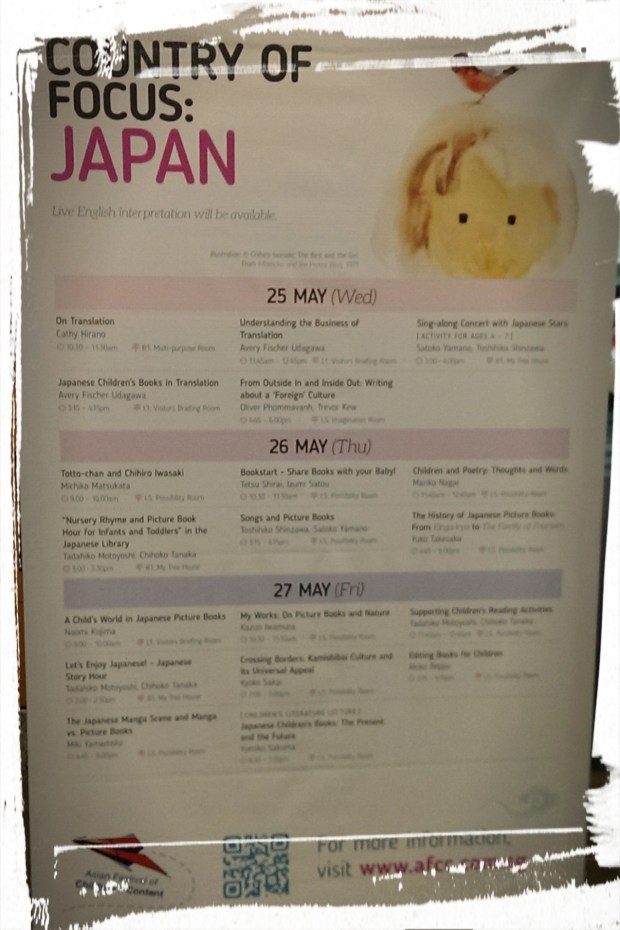
Scoring Fs at AFCC 2016


Event, Singapore – Down for my first AFCC ever, I noticed a few Fs along the way. Here’s a quick run through!

IMG_20160703_000104Festival – Truly a festival of children’s content with books, music, songs and games for children, and those wannabe grown-up ones like me.

Focused – Japan was the Country of Focus in SJ50 year, which brings me to…

Fortunate – How else could I have had a look in? (Well, it was very much thanks to SCBWI Japan.)

Fun-filled – Totally enjoyed every bit, from tending the Japan Booth, helping the rehearsals for Japan Night in a dimly lit SEA Aquarium, keeping time for a marathon storytelling hour, to attending some very insightful sessions.

Fascinating – Very often so, as I was captivated by the performances and range of stories that were on display.

Flashy – How else to describe an underwater launch of bilingual picture books? Maybe splashy?

Favourite – An oft heard question, but I just couldn’t find a Japanese picture book or illustrator that I could pin down as a favourite. I found that I like many of them for their different stories, styles and colours!

Fruitful – Learned much about presenting, displaying, sharing, reading and creating content for children.

Frank – A brief, serious mention that kamishibai, picture card storytelling theatre, was once used for war propaganda. Frankly and plainly put, well-received with appreciative nods.

and finally,

Forward-looking – Covering recent trends in YA literature in Japan, the closing session of the event also looked to a future that promises to welcome greater colour, depth and diversity in Japanese content.

So a quick tally makes it 10 Fs in all, and there’s room for probably a few more.

Dad book for dad


Book review, from Singapore to Tokyo – On a short trip to Singapore, I visited a familiar independent bookstore in Tiong Bahru, Woods in the Books. Every time I visit, I find something new. This time was no different.

My latest find was hidden between several other Epigram books. Something had spurred me to scour that selection, when a title caught my eye – “Don’t Be Sorry, Dad!”.

We clicked. I was sorry for leaving my kids and wife back home to venture out alone for purely selfish reasons. I wanted to do something worthwhile for them, bring them something that they would enjoy. A picture book was perfect. But what story did this one tell?

The cover shows a girl and her father seated on a bench in some park. Nothing extraordinary, or was it? Was it the title? I had to open the book to learn more.

When I did, I saw a young girl enjoying the company of her dad, who couldn’t walk but always gave her so many other things. Whether at the beach, the park, on a sunny day, or a rainy one, the father would always apologize for being poor company, but the little one kept repeating the title, or something similar, and showed him why it didn’t just not matter, but how she really liked spending their time together.

It was simple, inspiring, more like liberating. Often, I feel more than a few judgmental gazes around me when my kids start misbehaving on our many adventures beyond our front door. However, fathers are not usually represented with their children in Japanese media, but many can be seen playing, caring, watching over their children.

The stay-at-home housewife has an untouchable position in picture books. Today, we see some men do this job, but don’t get to read much about them. Even less so if it were about something so basic as a father-child relationship.

This book clicked. On several levels. The illustrations were soft and pencilled, not flashy. It told a simple story, with similarly simple, warm colours. The message seemed manifold. Acceptance, enjoying time together, appreciating another’s strengths and embracing their weaknesses. This, from the little girl’s perspective.

How can this not be a totally heartening book for all fathers? How often do fathers say sorry, with good reason? How we always hope to put a smile on our children’s faces? How, after reading, can we not think about our own fathers?

Thanks dad!

That would also be the best present I could ever receive from my children.

Title: “Don’t Be Sorry, Dad!” by Nari Hong based on her life

Published: Singapore, Epigram Books, 2016

A picture book of mirth and love…


Book review, Tokyo – On one of my frequent visits to the children’s section of a local bookstore, a familiar cover caught my eye. A lady ghost smiled warmly with a tear in her eye, holding a little boy tight high above a town in the light of the moon. A picture of mother and child separated by death no doubt, reaffirmed the title, “Mommy’s a Ghost Now!“.

I read this a few months back in some other bookstore. Then, I was drawn by the cover and had picked it up to see what stories it held. I recalled the sorrow, the tingling in my nose that grew into sniffles, and the ticklish vibes I got from the exchanges between mother and son. The pictures in the pages struck a chord, as I clearly remember tears welling up the last time.

This time was slightly different. I could read it more calmly, braced for the feelings and memories that were sure to grow as I turned the pages. And they did. Emotions had gotten the better of the reader in me the last time, probably more than just once. So I chose to focus on the text and pictures that told the story.

Roundish shapes, clear and distinct colors, the pictures seemed primed to brew humour. The text told a story of parent-kid bickering, over tiny details, countless I-told-you-sos and don’t-do-it-agains. All tinted by a sentimental  and funny take on a relationship that everyone can identify with, one that began with love from the start.

A picture book that exceeded my expectations, the title prepares readers for a story of mother and son coming to terms with her sudden and accidental death, and then being separated from her (and her eccentricities) by life and death. It seemed to suggest that it was all part of the journey for everyone, and, of course, the boy has to have his way of finding the courage and strength to live on.

Having read it more than once, it sure would make a special present, if I can emulate others in finding the courage to buy it for someone, perhaps for myself.

Title: ママがおばけになっちゃった!(Mama ga obake ni nacchatta, lit. Mommy’s a Ghost Now!)
by Nobumi
Publisher: Tokyo, Kodansha, 2015
http://children.kodansha.co.jp/en/books/picturebook/42631.html