Questions from The Ranch of Hope


Book review, Tokyo – Years after the 3.11 triple disaster, a rancher continues to tend to his herd of more than 330 cattle in a no-go zone in Namie, Fukushima. Portrayed as a nuclear rebel by parts of the media, the picture book behind the ranch raises some serious questions.

On the cover of “Kibou no Bokujo” (The Ranch of Hope), he could easily have been chewing in defiance on a burning cigarette. Instead, it shows a man with his dog, cat, and cow with the ranch in the background.

The pictures go from animals and houses abandoned after the disaster to the lone rancher who stayed behind to tend to his ranch. Inside, cattle eat, drink, defecate, and get hungry. The rancher continues his job, feeding and tending to them. Some of the weaker grow ill and die, but the rest have remained healthy, eating, drinking, defecating, and getting hungry again. Cattle numbers have recovered, it says, as the ranch took in those that had wandered near from elsewhere.

The touching parting gaze between another rancher and his endearing calf is paired with a page splashed in red with carcasses and several men in the faraway background clad from head to toe in white protective wear. In contrast, the owner of the Ranch of Hope goes around doing his daily chores in his regular farming attire. He is simply doing his job, keeping his cattle fed and alive, even if they can no longer be sold because no one would take them.

The story goes deeper, into the rancher’s thoughts – what is the meaning of life, of plentiful rice fields, rivers teeming with fish, clean fresh air, a local brand painstakingly built up by the community over the years, that vanishes just like that?

The book’s sobering pictures serve as a reminder of the gravity of some decisions in life, which are made by a few and end up affecting many others.

Title: 『希望の牧場』 (Kibou no Bokujo, The Ranch of Hope)
text by Eto Mori, illustrated by Hisanori Yoshida
Publisher: Tokyo, Iwasaki Shoten, 2014

Ideas from the man on the 10,000-yen note


Book review, Tokyo – 10,000 yen is about 100 US dollars. So, a Fukuzawa is about a Ben Franklin, money-wise. ”Who?” you may ask. While the founding father is widely known for his adventures with kites and lightning, the former is no where as famous, possibly even in Japan.

So again, who is this man, the face on Japan’s most valuable note in wide circulation?

Fukuzawa is, in fact, the founder of Keio University and a forward-looking thinker at the time of the Meiji Restoration in Japan. When Japan faced colonial pressure and technology, Fukuzawa published “Gakumon no Susume (Encouragement of Learning)” to advocate learning to build knowledge and individual prowess to ensure sovereignty. He was quite a figure in the modernization of Japan. (His reputation after that requires more careful research, for me at least.)

A few months back, I found “Kodomo no ‘Gakumon no Susume’“, a book that re-presented his ideas for primary school children. Among the series of such books by Takashi Saito, which includes the Analects of Confucius, this one caught my eye because I was looking for something from Japan, and about it.

My immediate impression was the universality and relevance of his ideas. Nothing too overwhelming. Just simple ideas on tolerance, diligence, honesty, righteousness and good demeanor, just to mention a few.

A familiar board-gamesque path lining the page borders illustrate each of his 19 ideas, leading the reader from start to end. A learned bird donning a graduation cap would sometimes offer prompts to help the reader understand and think deeper.

Fukuzawa himself is known as a keen student and translator of Chinese, and later European and American thinking and sciences. He clearly found many dots in the course of his learning that he connected to form his own coherent ideas. To me, this was the master demonstrating to would-be students how to acquire information to create new knowledge.

The Internet is today often our first, immediately-available, omnipresent, go-to data source, but I shudder at how information is sometimes generated online, let alone have knowledge created from it. To me, learning and questioning have never been more important, and perhaps it is this urge that led me to acquire this book for myself.

Maybe only Keio University alumni and note maniacs or collectors would dig deeper into the face on the 10,000 yen note. Neither of these am I. But the ideas in this reworked version struck me as immensely relevant, and I am sharing my thoughts here to help foster the formation of new knowledge, and understanding.

Title: こどもの「学問のすすめ」(Kodomo no “Gakumon no Susume”, lit. “Encouragement of Learning” for children)
by Takashi Saito
Publisher: Tokyo, Chikuma Shobo, 2016 8th reprint (1st published in 2011)

Dad book for dad


Book review, from Singapore to Tokyo – On a short trip to Singapore, I visited a familiar independent bookstore in Tiong Bahru, Woods in the Books. Every time I visit, I find something new. This time was no different.

My latest find was hidden between several other Epigram books. Something had spurred me to scour that selection, when a title caught my eye – “Don’t Be Sorry, Dad!”.

We clicked. I was sorry for leaving my kids and wife back home to venture out alone for purely selfish reasons. I wanted to do something worthwhile for them, bring them something that they would enjoy. A picture book was perfect. But what story did this one tell?

The cover shows a girl and her father seated on a bench in some park. Nothing extraordinary, or was it? Was it the title? I had to open the book to learn more.

When I did, I saw a young girl enjoying the company of her dad, who couldn’t walk but always gave her so many other things. Whether at the beach, the park, on a sunny day, or a rainy one, the father would always apologize for being poor company, but the little one kept repeating the title, or something similar, and showed him why it didn’t just not matter, but how she really liked spending their time together.

It was simple, inspiring, more like liberating. Often, I feel more than a few judgmental gazes around me when my kids start misbehaving on our many adventures beyond our front door. However, fathers are not usually represented with their children in Japanese media, but many can be seen playing, caring, watching over their children.

The stay-at-home housewife has an untouchable position in picture books. Today, we see some men do this job, but don’t get to read much about them. Even less so if it were about something so basic as a father-child relationship.

This book clicked. On several levels. The illustrations were soft and pencilled, not flashy. It told a simple story, with similarly simple, warm colours. The message seemed manifold. Acceptance, enjoying time together, appreciating another’s strengths and embracing their weaknesses. This, from the little girl’s perspective.

How can this not be a totally heartening book for all fathers? How often do fathers say sorry, with good reason? How we always hope to put a smile on our children’s faces? How, after reading, can we not think about our own fathers?

Thanks dad!

That would also be the best present I could ever receive from my children.

Title: “Don’t Be Sorry, Dad!” by Nari Hong based on her life

Published: Singapore, Epigram Books, 2016

A picture book of mirth and love…


Book review, Tokyo – On one of my frequent visits to the children’s section of a local bookstore, a familiar cover caught my eye. A lady ghost smiled warmly with a tear in her eye, holding a little boy tight high above a town in the light of the moon. A picture of mother and child separated by death no doubt, reaffirmed the title, “Mommy’s a Ghost Now!“.

I read this a few months back in some other bookstore. Then, I was drawn by the cover and had picked it up to see what stories it held. I recalled the sorrow, the tingling in my nose that grew into sniffles, and the ticklish vibes I got from the exchanges between mother and son. The pictures in the pages struck a chord, as I clearly remember tears welling up the last time.

This time was slightly different. I could read it more calmly, braced for the feelings and memories that were sure to grow as I turned the pages. And they did. Emotions had gotten the better of the reader in me the last time, probably more than just once. So I chose to focus on the text and pictures that told the story.

Roundish shapes, clear and distinct colors, the pictures seemed primed to brew humour. The text told a story of parent-kid bickering, over tiny details, countless I-told-you-sos and don’t-do-it-agains. All tinted by a sentimental  and funny take on a relationship that everyone can identify with, one that began with love from the start.

A picture book that exceeded my expectations, the title prepares readers for a story of mother and son coming to terms with her sudden and accidental death, and then being separated from her (and her eccentricities) by life and death. It seemed to suggest that it was all part of the journey for everyone, and, of course, the boy has to have his way of finding the courage and strength to live on.

Having read it more than once, it sure would make a special present, if I can emulate others in finding the courage to buy it for someone, perhaps for myself.

Title: ママがおばけになっちゃった!(Mama ga obake ni nacchatta, lit. Mommy’s a Ghost Now!)
by Nobumi
Publisher: Tokyo, Kodansha, 2015
http://children.kodansha.co.jp/en/books/picturebook/42631.html

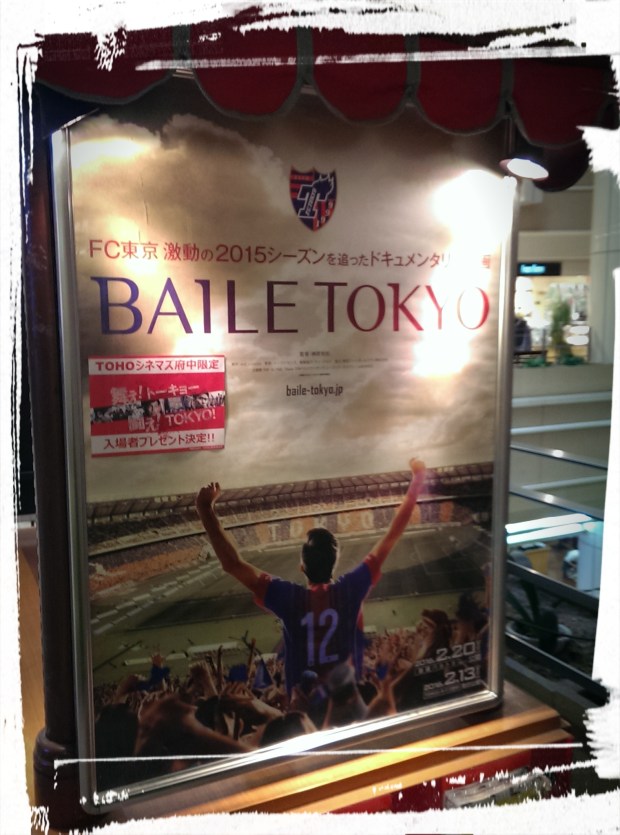
FC Tokyo documentary invites viewers to co-write club’s history


IMG_20160221_163133Film review, February 21, Tokyo – Bring a football team from the nation’s capital and a movie production team of club fans together and you get a documentary. Simple? Not really. “Baile Tokyo – Weaving the History” was shot over the 2015 J-League season to tell the story of the ups and downs of a year that promised so much but delivered too little.

Followers will remember the early euphoria from sitting joint top with Urawa in the early part of the 2-stage format competition, the mixed farewell to striker Yoshinori Muto’s mid-season departure to Mainz, and the despair of the scoreless draw with Sagan Tosu on the last day of the season that left them short of a chance at the league’s top prize. Dedicated fans would also recall the season-ending away loss to Hiroshima in the Emperor’s cup semi-final.

Yusuke Sakakibara’s first full-length documentary speaks to fans and wannabes, drawing on the mutual affection amongst the players and with their fans. Mixing stock footage with press statements, casual conversations in relaxed settings, and the occasional training session, the to-and-fro disrupted attempts to create a coherent message but combined well to tell the story behind an up-and-down season.

Documentaries normally focus on characters or themes to build stories around them. Sakakibara chose to shine the spotlight on a select group of several persons in and around the team. Players, officials, supporters were covered along with the club physio, in a sub-narrative of a battle for fitness after injury, a topic that is often said but not necessarily properly portrayed as part and parcel of sport. Officials were roped in to clarify the club’s ambitions – bring Tokyo to the top of Japanese and Asian soccer – even though they admit that the team hasn’t won the domestic title.

On the business side of things, it tried to scratch the surface of fanbase growth and media coverage. Japan’s capital has a broad, vibrant population that has the potential to bring in massive turnstile receipts. Indeed, FC Tokyo boasts an attendance of 28,000 per home game, second only to the fanatical Urawa Reds support, but this intake hardly fills even three quarters of its 50,000-seater Ajinomoto Stadium. Half-hearted media coverage and mediocre performances had promised to change with the prolific Muto, but he left midway, as the film reminds us.

Football fans often rankle and fume about how their team lost, was unjustly penalized, and feel joy at a lucky escape and pride at a well-earned win. Involvement is emotionally charged, whether in the stadium or off it. The documentary did well to paint sentimental farewells to fond faces, most notably Muto and Kosuke Ota. The emotional roller coaster ride is probably its best part, so fans have been warned – bring your tissues.

Overall, the film echoed the club’s ride in 2015, opening with promise and trying to end on a positive, forward-looking message, by mentioning its new B team’s participation in J3, Japan’s third tier. So it was half-expected to run out of time, or steam like the team did in 2015, and viewers are left with the choice of leaving their memories of 2015 at the cinema or continue writing the next chapter of FC Tokyo’s history together with the club in the new J1 season, starting on February 27.


“Baile Tokyo – Weaving the History” is directed by Yusuke Sakakibara. Opened on 20 February (Sat.) at 19 theaters across Japan, including Toho cineplexes in Fuchu, Odaiba, Shibuya, Shinjuku, and Yokohama. Fuchu Toho cinemas opened for prescreening on 13 February and is giving out 3 special edition movie postcards per viewer while stocks last.

Official website (in Japanese only): http://baile-tokyo.jp

Economic indicators for happiness?


Book review, Tokyo – What does it mean to be economical? Does it mean living within one’s means? Prudence probably sums that up better. What about only using what we need? That’s being frugal. Maybe being economical is about getting our money’s worth, and economics about efficient distribution of limited resources. Time is money, goes the old adage. So who’s measuring how we use our time for something worthwhile?

Modern life is about being tied, to loans, debt and feeding the ravenous monster that is the world economy. Countries chase numbers to pull in money for growth and indicators, to make sure the huge monster stays happy. Have we taken the time to stop and think about how happy we are as a cog in this unstoppable machinery?

Is it surprising that a picture book with a profound message that is more than 5 years old strikes more than a simple chord with someone in finance? The speaker, a former guerilla fighter, also happened to be the simple, frugal former head of state of a nation once known as the Switzerland of the Southern hemisphere, who featured in a series of Japanese books. Before these two picture books by Chobunsha, how the two languages sounded was the most obvious link between the two countries. The books created a new one, the ideas of former Uruguayan President Jose “Pepe” Mujica.

The first picture book released in 2014 vividly illustrated the then president’s simple, frank Rio+20 speech of his view on the state of human civilization. Lives misled by the demons of desire that end unfulfilled, saddled and ultimately crippled by debt. He proposes a rethink of our goals, our lifestyles at the fundamentals of modern society. He was content with his, tending to his vegetables, chickens, and refusing his official ride but indulging in a simple daily dose of tea. Acknowledging the importance of work to society, he leaves hints to being content and happy. His message that day still rings strong in Japan and recently Taiwan, and on Youtube, in the world’s search for sustainability.

The second book, a follow-up nearly 18 months later, is a longer, deeper look at the story behind the man who made that speech. Compiled from years of speeches and an interview after he was relieved of his stately duties, the book brings readers on a journey through his past as a guerilla fighter, the things, books and people, that changed him, and his thoughts on the future that we can fight to create.

The second book specifically mentioned Asia, hinting at the value of Asian teachings. By doing so, he seems to suggest that, when the time comes, Asia and its values would promise a chance to move the world in a new direction, toward a new type of life.

The illustrations and stories in these books are targeted at children, but the ideas are ones that adults relate more easily to. These books invite reflection and interaction, to discuss and find a way forward. It found success in Japan with a thoughtful population seeking escape in a time of a pro-growth national policy. So why not in other societies or markets that chase the same lofty highs? The language is the first barrier, the unconventional ideas are the next. Hopefully, we will get to see these books in English, preferably sooner rather than later. Otherwise, we’ll all have to depend on the Japanese and Chinese to work on finding happiness together.

“Sekai ichiban mazushii daitouryou no supiichi (A speech by the world’s poorest president)” was later translated into traditional Chinese as “Quan shijie zuiqiong de yeye lai yanjiang” by RuHe publishing. “Sekai ichiban mazushii daitouryou kara kimi he (A message from the world’s poorest president)” was released in October 2015 in Japan.

Publisher Jp:

  1. http://www.choubunsha.com/sp/book/9784811320670.php
  2. http://www.choubunsha.com/sp/book/9784811322483.php

e-commerce Tw: http://www.books.com.tw/products/0010689941

(Removed) J-Lit Center En

(Added) Retailer Kr:
http://www.kyobobook.co.kr/product/detailViewKor.laf?barcode=9791156130628

(Added) Publisher En:
The World’s Poorest President Speaks Out
Enchanted Lion Books, 2020

Staying on top with a book


Tokyo, 5 June – The Japanese Women’s national football team are enjoying a golden era. Sitting pretty atop the world since 2011, they went on to narrowly miss out on the 2012 London Olympics gold, but bounced back to win the last edition of the Asian prize in 2014. Nicknamed Nadeshiko Japan, the former a Japanese variety of the carnation and a synonym for reserved resilience in Japanese women, the team have had a few wobbles in their run-up to the 2015 Women’s World Cup starting tomorrow. Off the pitch, preparations to consolidate themselves at the top of the game have already gained ground in Japan.

My interest in football and children’s content drew me to this book a few months back, waiting quietly amidst the Doraemon corner of a bookstore. (Take a quick peek inside at: http://sample.shogakukan.co.jp/bv?isbn=9784092538573)

Pulling it out of the pile, straightaway the words on the cover struck me – for girls and boys alike! The order was clear, the target pretty high. Doraemon fans would be quick to realize that Shizuka has some innate sporting ability (when she did a body swap with Nobita and played a blinder in a baseball game), but the book goes beyond that by bringing in a new girl classmate. And guess what, that girl is an expert in football.

The book brings the usual suspects through a journey of learning the basics, from passing, heading, trapping and dribbling littered with rather blunt jokes by the willing cast. Besides the story, the book doubles, or rather it’s primary purpose is, as a quick intro to the rules of the game. It goes further, describing mini-games and drills to do with friends or alone. Moving through awareness of team mates and passing to tackling dribbling in the latter pages, the editors obviously recognize the difficulty and skill involved to maintain reader interest as she/he developed. A Shizuka-chan mini-series runs inside too, where she goes through some exercises to familiarize with the ball. The target can’t be any more clearer, and as a parent that would gladly take his children to a game, the idea certainly sold very quickly.

In my everyday routine, I’ve noticed many children’s football teams in Japan, and all-girl teams are not uncommon. The supervisors of this book, the Japan Football Association, obviously recognizes that for girls to develop their game, they have to play with their friends, and that often means playing among the boys, as did Homare Sawa, Japan’s most capped women’s player.

She’s no longer the captain, but still a highly influential figure on and off the pitch. The Japanese team is simply a joy to watch. They pass, link up and use the occasional dribble and feint to create and find space for team mates to capitalize. Not the most physical team around, their work and organization as a team are excellent. However, their recent string of successes seems to created some pressure, but the media have been very supportive, unlike their often scathing coverage of the men’s team. With such warm support and a book like this to help unearth and nurture new generations, I sure hope we get to enjoy this brand of football at the highest level in years to come!

『ドラえもんのスポーツおもしろ攻略 サッカーが楽しくできる』
(Doraemon Fun Sports Guides – Enjoy Soccer)
Shogakukan, Dec. 2013, 850 yen + tax
(http://www.shogakukan.co.jp/books/09253857)

Japanese reimport


Who is this masked cat?

Who is this masked cat?

From Tokyo to Singapore, 2 May – This is a tale of a reimport from Japan. It began one fine day in April, when a colleague asked whether I had heard of “The Tiramisu Hero”, since they apparently hailed from Singapore. Flabbergasted at another head-shaking, hand-flapping display of my utter lack of knowledge about developments back home, I held on frantically to the only hot lead – it was wildly popular in Japan.

Dr. Google told me that the traditional Italian dessert was being sold by a Zorro-masked cat on Rakuten, a major e-commerce portal in Japan. It had it’s own page, and a virtual queue of a lengthy 4 months. One post from a satisfied customer said it was simply worth the wait, which he/she almost forgot about, but that was balanced by others saying that they had ordered a month ago and were still waiting, or that they would have preferred if the store provided a delivery date. That’s something customers would expect from online on-demand sales, especially with hotter weather and vacation season coming our way.

Further digging revealed that the store began with an online presence before a real cafe opened in Oct 2013 in Singapore. 3 months later, they began making their rounds in major malls in Japan.

Sir Antonio's playground

Sir Antonio’s playground

I decided to unmask the cat by venturing into its den. I found it right next to the Lions’, by which I mean the spiritual home of the Singapore national football team in Jalan Besar. The Tiramisu Hero cafe stood right across the street. Accompanied by ready eaters, I strolled past the grass porch and the tables set outside to the air-conditioned abode of the cat and its desserts.

My eyes were immediately drawn to the internal deco. A larger-than-life head of Sir Antonio, the name of the cat as I later found out, ladders were everywhere, standing on the ceiling above, lying on it, and one that stood from ceiling to floor. Sir Antonio adorned the entire cafe, flying above, hiding in space, caressing corners, posing in costumes, as he welcomed visitors to his impressively doodled lair. The signature mask and moustache were soon imprinted in the minds of visitors.

Sat down at the table, I checked out the menu. Littered with cute illustrations that teased your imagination of how the dish would be presented, our eyes fed on main course options from fish and chips to fresh pasta and familiar sides like mushroom soup, garlic bread and fries. Standard western fare.

More creamy than chunky, but great garlic side!

More creamy than chunky, great side!

Crispy, juicy fish and chips

Crispy, juicy fish and chips

We ordered a conservative selection of chunky mushroom soup, fish and chips, aglio olio (angelhair pasta) and savoury creamy salmon. Of course, that was rounded off with tiramisu, brownies and mud pies. A brownie came with each set, but for some reason, some were replaced with fluffier fudge-glazed chunks that tasted like carrot cake, which were still yummy but off-menu. The swap was never explained but we paying customers didn’t either, as we half-enjoyed the surprise. The mud pie was plain sinful indulgence.
Plain indulgence

Plain indulgence

The bits of food were solid, not fantastic. The mushroom soup was more creamy than chunky, while the garlic bread on the side was superb, crisp and full of flavour. That said, our selection was especially garlicky. Aglio olio was simply overpowered by the delicious bulb. Accented by bacon bits and other spices, the angelhair simply didn’t figure other than to keep the pieces together. The fish and chips were crisp and juicy, and the expertly done salmon was accompanied by sticks of asparagus. All very nicely presented, but the greens tasted thick and unshaven. Picky eaters would probably have shunned it at first sight.

Buon appetito!

Enjoy it like so… Buon appetito!

Peering from under the covers?

Peering from under the covers?

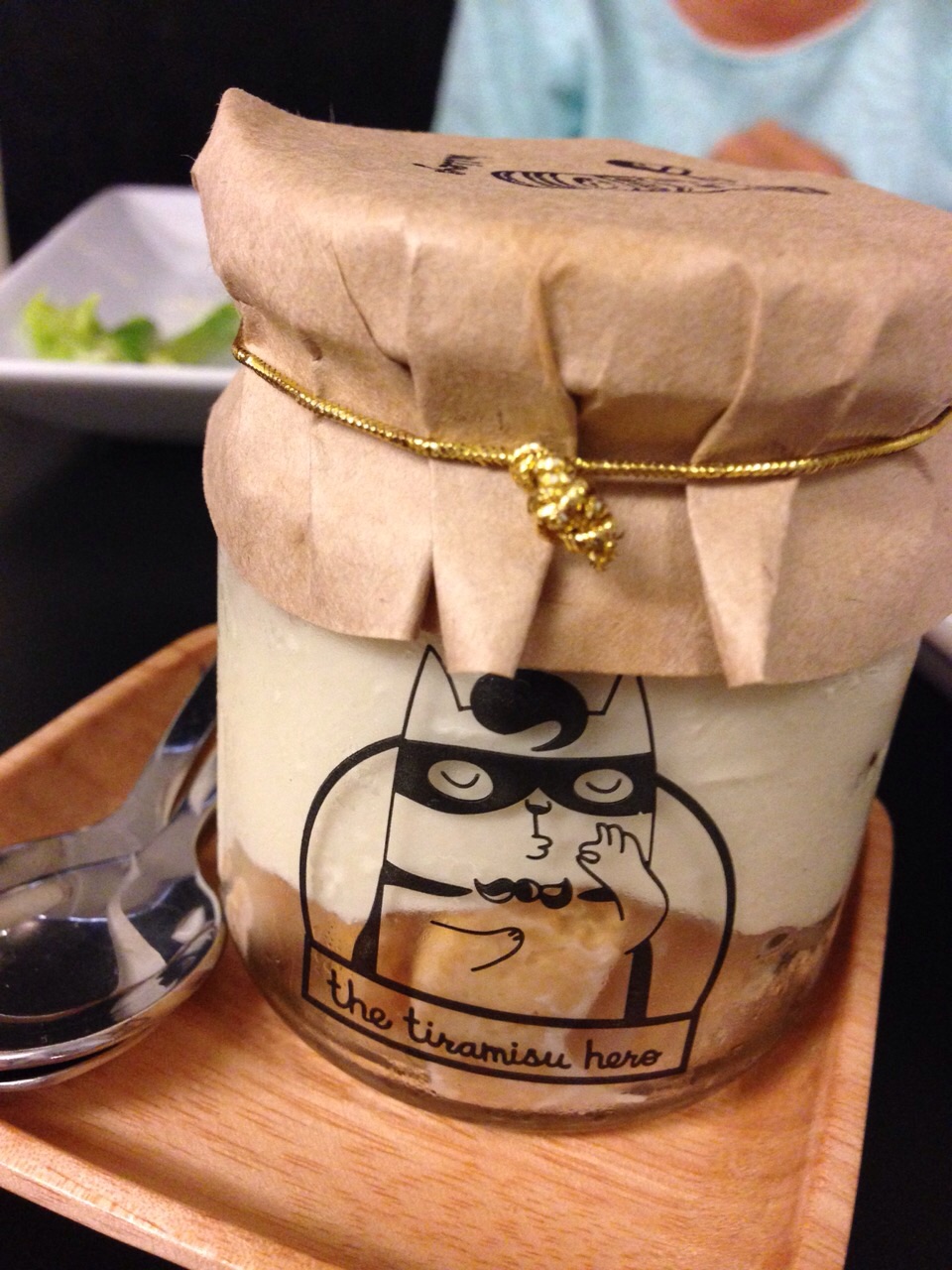
Finally it was rounded off with the cafe’s namesake dessert. Original or Bailey’s, milo, kaya, durian even. Spoilt for choice and making the mistake of ordering our fixes after the meal, we had to settle for the first two. Served in cute glass bottles with Sir Antonio in various poses, the brown paperbag cover over the tin cap identified the liquid used within. All that just waiting to be opened and a spoon to sink into. Sir Antonio is a true hero of eye and mouth candy.

Aww.... goodbye for now

Goodbye for now

Open 11am-10pm

Budget: Around S$25 per person

Location: Shophouse opposite the hawker center at Jalan Besar Stadium

Seats: About 25 with Sir Antonio inside and another 10 without