Adventure at Japan’s theatre of sport


Tokyo – It was the morning of May 22nd, the last day the Japanese National Stadium would be open for tours to the public before renovations ahead of the 2020 Olympics. I took the day off to become part of the 6,000-strong weekday crowd, taking the municipal subway line to take me straight to its North gate.

Taking my first and last steps through the gates, I looked to the queue ahead. Snaking across the entrance platform was an excited but orderly crowd, a mix of parents with carriers and strollers in tow, couples, chatty girls and wide-eyed boys. I spotted a few sporting soccer jerseys and some others clad in business suits. They had obviously gone out of their way to take time off for the tour and were all set to get back to work.

As we shuffled toward the tour entrance below, some were conspicuously out of line, peering anxiously past the gates while feverishly urging their friends to arrive over the phone as others frantically fingered their smartphone screens. Staff were unraveling more rope to round up the growing queue but a few were already hollering for last-minute entrants ahead of shutting the gates. Time was of the essence.

Enjoying the intermittent windows of sun, I gazed upward for signs of rain clouds as a chilly breeze picked up because rain was forecast later in the day. A large menacing mass drifted nearer, threatening to open up and dump whatever it held. As we moved down to the tour entrance beneath, I caught my first glimpse of the track and field through a ground-level entrance. The brilliant green glowed brilliantly beyond the pitch dark entrance. The pitch did not welcome, it drew you in. Restrained by my orderly habit, I prised my eyes away and turned to the queue ahead.
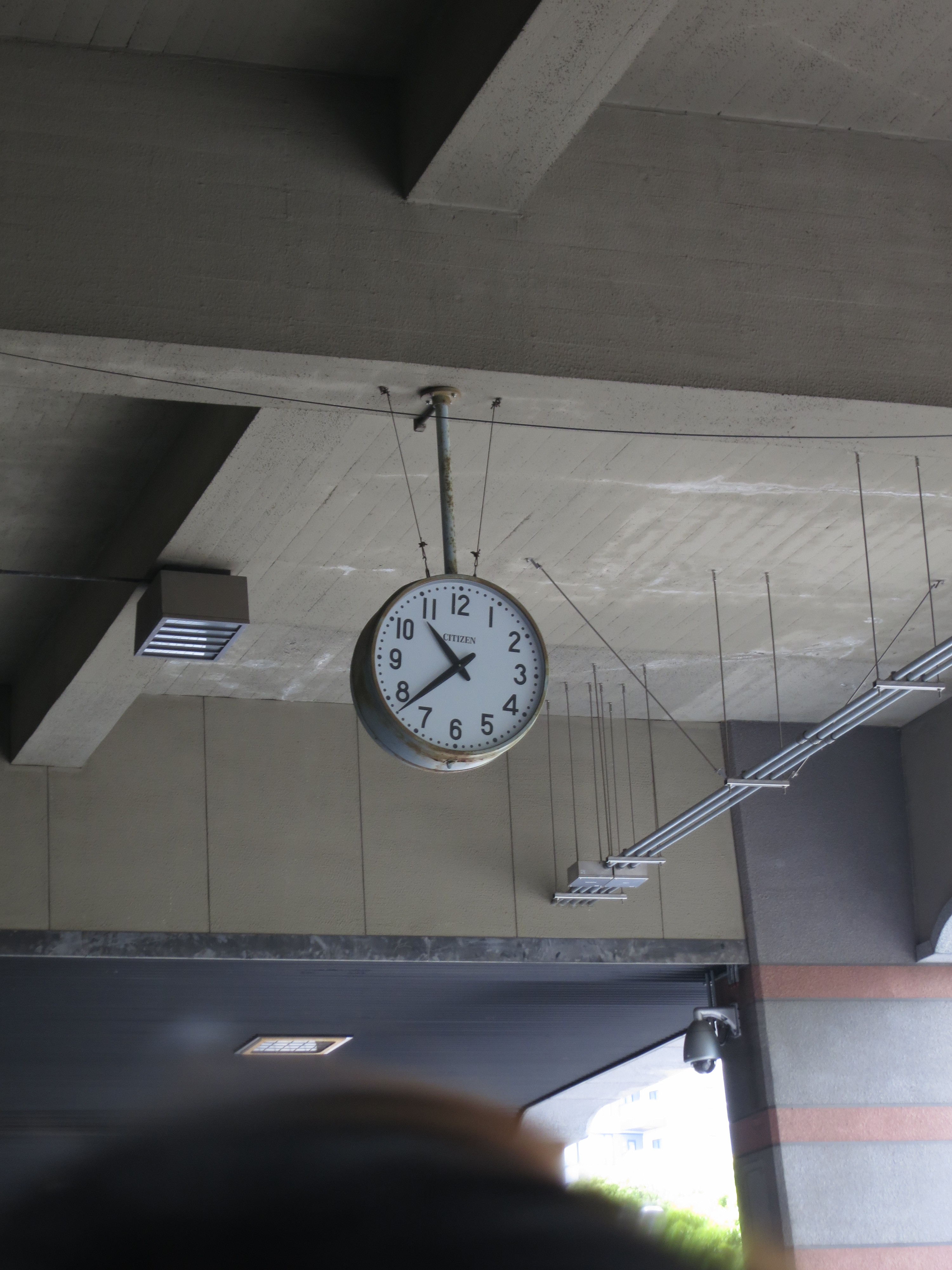
A crooked clock hung above the tour entrance

A crooked clock hung above the tour entrance

I noticed a slightly crooked clock right above the tour entrance, which was laid out haphazardly using a few tables and benches. No one really noticed the alignment of the clock above it, except for the time. We were in for some history, but first we had to pass by an open cash box, some stacks of papers, and clammy hands snapping away at the 1,000 yen entry fee, before receiving a visitor access pass.

Liberated from the ordeal of the snail-paced queue, I charged out into the open to the curved road around the stadium.
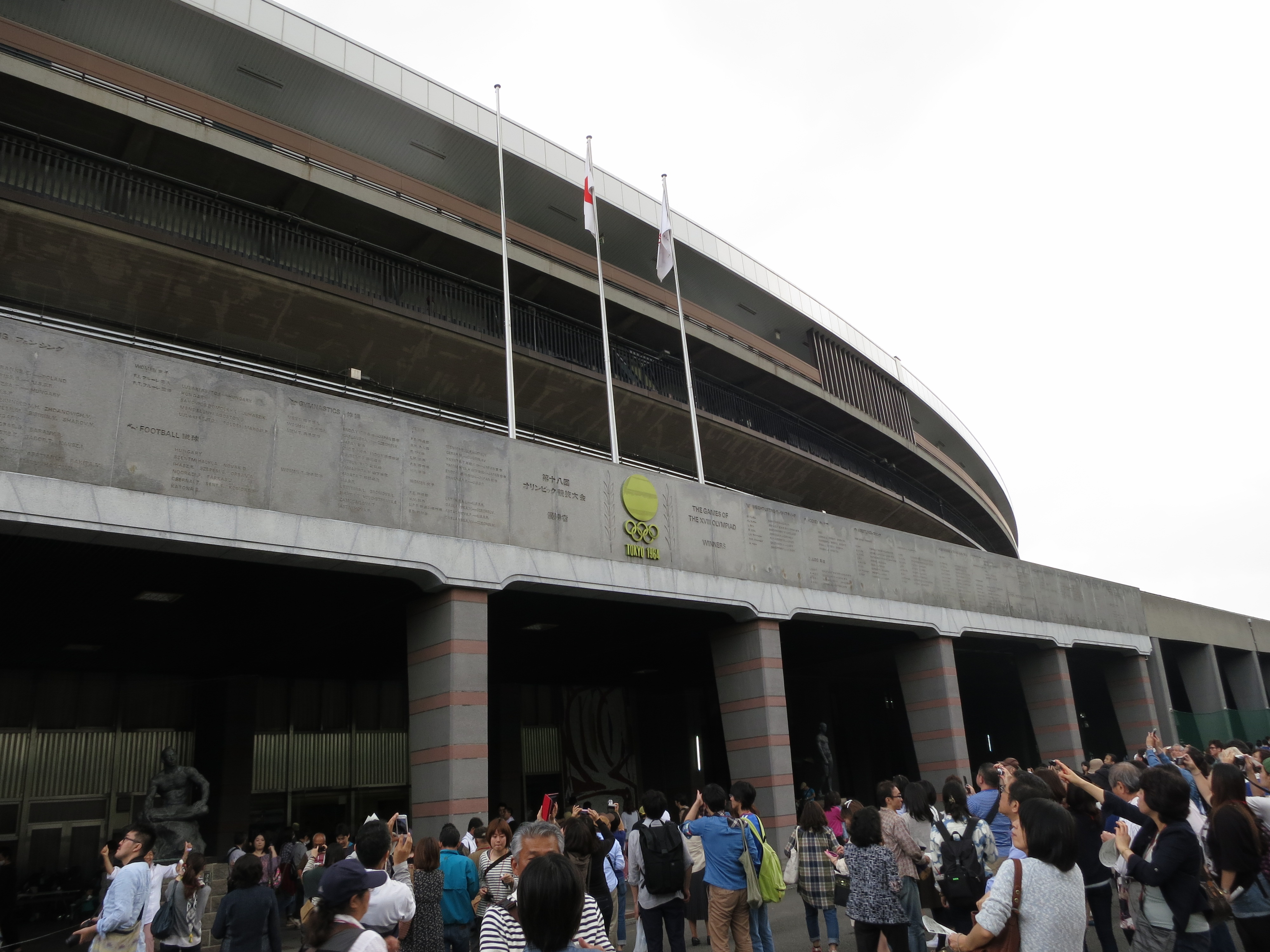
1964 Olympic winners plaque and flagposts

The 1964 Olympic winners list

Many were pointing their cameras upward, toward the trident flag posts and the 1964 Olympic winners list. Carved in stone and perched high above us, we stretched to search for familiar names only to be met with droplets of rain. I remembered the momentous triumph of the Japanese women’s volleyball team and snapped a few quick photos before dashing off past another crowd (and winners board) to the main attraction: the sporting arena within.

Ground-side view of the pitch and terraces

Ground-side view of the pitch and terrace

By then, some brollies had gone up but sports enthusiasts are not the weakly kind. I found myself angling for a shot of the pitch among the many lined up along its perimeter. Some crouched down to caress the grass while others stood still to enjoy the expanse of the pitch and the ground-side view of the main stand terraces. As the droplets fell harder, the field embraced it and glistened vividly. Any joy was soon dampened as the winds picked up and forced us to take shelter.

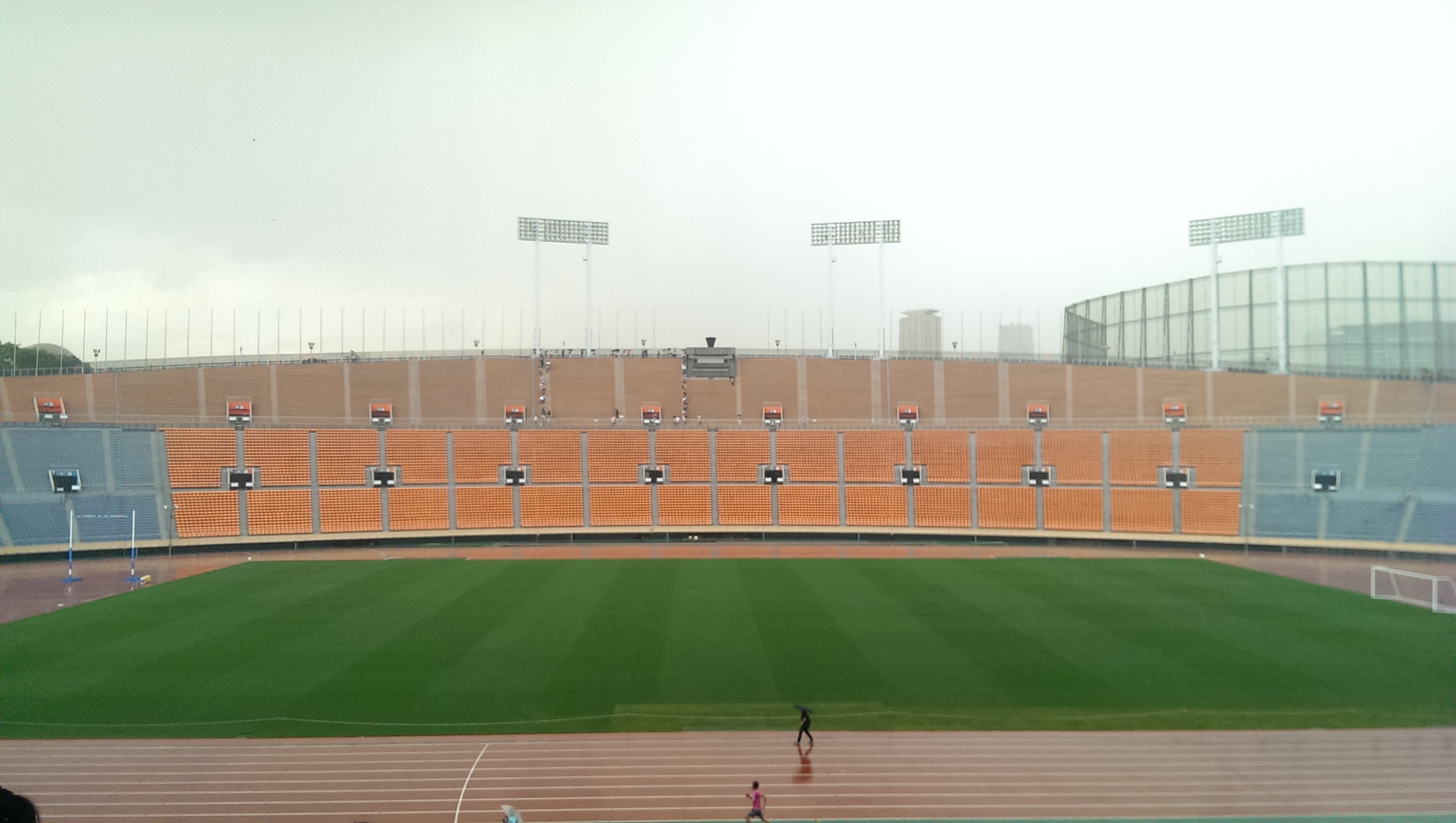
Mother Nature's performance - a hallowed field

Mother Nature’s performance – a hallowed field

One brave figure remained on the tracks under an umbrella as the heavens opened. Another lone figure, a visitor, soon accompanied him, trudging up and down the length of the pitch, seemingly oblivious to the increasingly heavy downpour. The rest of us were left cowering from the fury of the wind and rain, seeking shelter under entrances, covered terraces and walkways. As the storm reached its peak, rain splash formed a fleeting calf-high mist as mother nature demonstrated her craft in creating a hallowed field.
Main stand view

Main stand view

I stole on an intermission in her performance to make my way up the main stand, only to be greeted by a stream, a result of gushing drainage outlets at the sides of the aisles. Sloshing up the slippery concrete steps and moderately strong current while being pelted by large droplets of rain, I took the fastest possible route to an open seat in the covered stands, brushing past two ladies who stalled midway in the rain with their brollies. Seating myself down in the main stand, I noticed someone starting off on the home stretch. He tore through the light rain and fell theatrically at the end, drawing warm applause for the performance. “That was pretty fast!” some said, amused and happy to have seen good sport today. My spectator experience thoroughly satisfied, I ventured forth to the cauldron atop the opposite stand.

I joined the crowd on an flanking move. Making my way through the ground entrance and up a flight of stairs to the upper stands, I reached gate 37, the entrance leading to the famed cauldron. Once again out in the open, this time without any cover in sight, I glanced up the towering floodlights. The rain cloud was moving east, leaving clear blue skies behind its gray trail.

A familiar backdrop adorns the main stand

A familiar backdrop adorns the main stand

Turning round to the west, my eyes immediately recognized the familiar Shinjuku skyline. Just a stone’s throw away, it seemed even nearer as a pretty backdrop adorning the main stand. A spectator tormented by the sight of his team could simply look away to enjoy the concrete landscape that stood over the horizon. The sight was enough to keep anyone distracted till something exciting happened on the grounds below.

Impeccable orderliness demonstrated once again

Impeccable orderliness demonstrated once again

The back stand’s main attraction awaited. I refocused my thoughts and rejoined the queue. A single file formed along an aisle toward the cauldron. I waited in line, amazed by the live demonstration of impeccable orderliness so characteristic of Japanese society. We all played our part, shuffling toward the cauldron to take a prized photo or two. That was all the time we afforded ourselves with the crowd breathing down on us. Some took selfies in their business suits, others perched atop the fences or searched for the best possible composition. All this happened in line, with the rest of the stands empty. We all knew where the best vantage was, just follow everyone else!
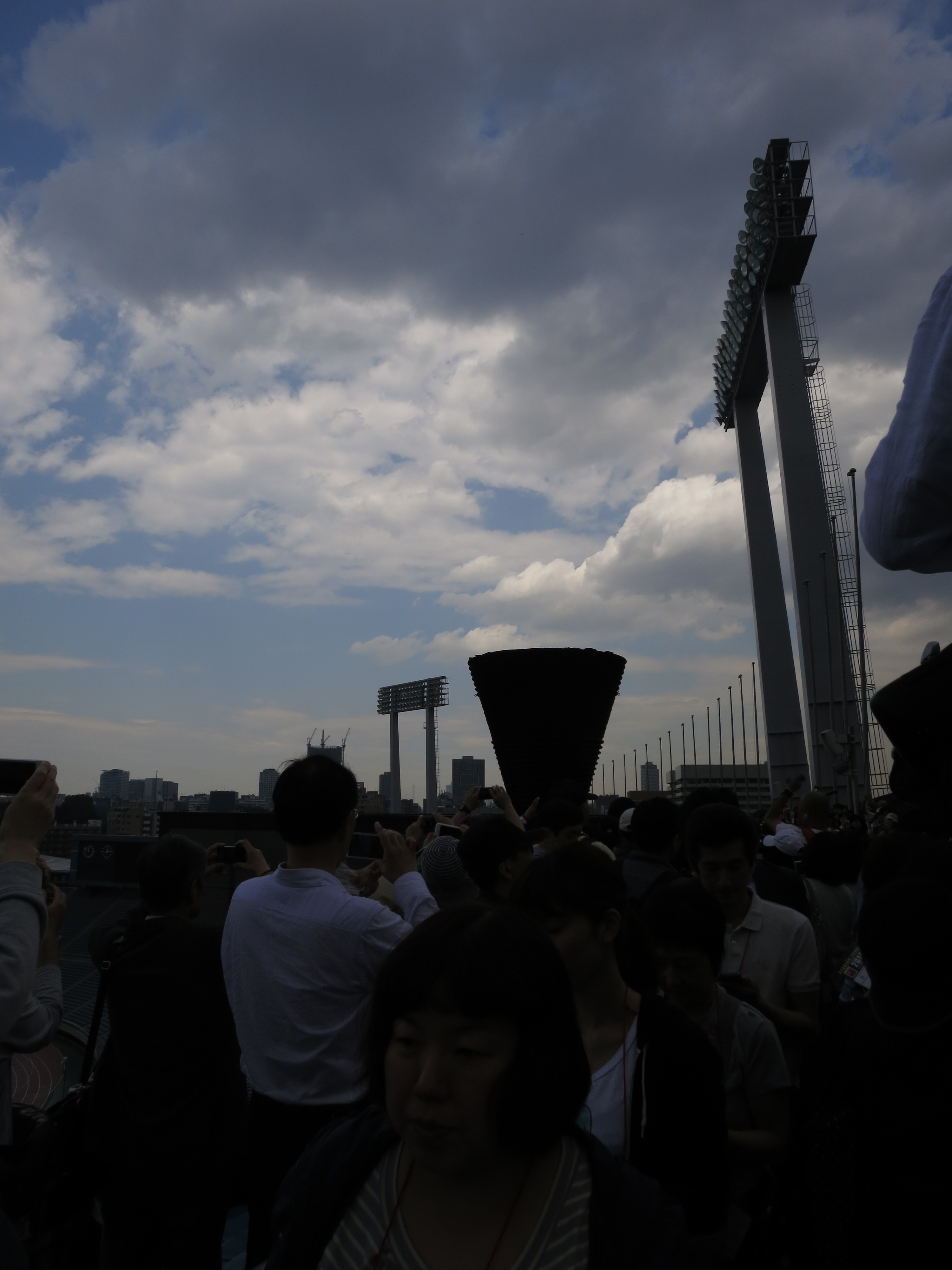
Rain clouds left behind clear blue skies

Rain clouds left behind clear blue skies

Past the cauldron, the line disappeared, the tension dissipated, and the euphoria subsided. A sense of nostalgia tinged with longing sadness quickly took hold. I would have loved to see a game here. Any sporting event, just to feel the wind in my hair and cheers reverberating across the ground. The open skies, flowing terraces, and flights of stairs in this arena was deprived of sporting endeavor, save the lone runner and some soccer jerseys. What will the future hold for its new incarnation? Its design will hold the key to the answer, and without doubt, it will not just be sport.

The crowd-guided tour had dispersed and I made my solo exit through an adjacent gate. It was the only other one open to us that day, waiting to be shut like the rest of them until the final farewell on the following weekend.

Gates closed

Gate closed

As I made my exit, a local TV station caught a fellow visitor in Kashima Antlers colors, who was chatting away happily into the camera. On the way back down the last flight of stairs, I received a towel to remind me of my adventure in one of Japan’s sporting monuments.

Hike reaping more for less


Tokyo – Since Japan’s sales tax rose to 8% on April 1, 2014, I’ve noticed some changes, particularly in the way prices are shown. Major supermarket chains jumped on a legal revision to show prices less tax before the hike. Before, it used to be mandatory to display tax inclusive retail prices throughout the country, but today, we get tax exclusive prices, along with the more familiar tax inclusive ones in parentheses. Conditioned to non-bracketed figures, a shopper’s mind will register the lower prices, even as it recognizes the significance of the bracketed (tax inclusive) figure in peripheral vision.

Not that I don’t get along with the number 8, sharing the same sound as prosperity in Mandarin, it’s the best number businesses can wish for. That has rung true here in Japan. Even as Starbucks has taken a slight hit on its tall-sized beverage, which now costs not 15 or even 20 but just 10 yen more at 350 yen, elsewhere, math seems to be an urgent subject for revision. Haircut chain QB raised its flat 1000 yen cuts by 80 yen, even as they offered the old price for senior citizens on weekdays. Vending machine prices have also gone up by a dime, which is around 8%. Well, at least we all know who’s counting their pennies here.

Cents really do matter in Japan, a country famous for clockwork train services and attention to detail. After years of molding 5% prices and making them attractive propositions, the 3% hike has created mental challenges and added unwieldy change in our pockets. Imagine trying to keep your shopping under 1000 yen by grabbing groceries for 94, 380 and 460 yen, tax exclusive, preparing a nice bill in line, and ending up having to find another 8 yen. Try ruffling through loose change under the anxious gaze of other people in the queue. I’d probably give up, pay with the nice 1000 yen bill plus a 10 yen coin hastily retrieved from my already bulging store of coins. The mint in Hiroshima has done shoppers no favours, ending its four-year break to meet an expected surge in demand for 1-yen coins.

Toll fares also rose on the same day, or rather expressway operators chose to change their discount scheme to charge daytime drivers more. A night drive from Tokyo to neighbouring Yokohama on the Tomei expressway is now 30% more expensive unless you passed the toll gates after midnight. That’s another huge blow to logistics companies who will have been scratching their heads for answers to gas prices that have been flying through the roof since the yen began its slide.

Drivers aside, I can see shoppers swarming to limited time offers and daily bargains at supermarkets. The Uniqlo phenomenon is proof of thrifty shopping habits: a prolonged campaign of weekend hard bargains means Uniqlo shops are empty the rest of the week. It’s not hard to see people ask whether anyone would buy a garment that is not a rock-bottom offer. I can see businesses timing their own hikes with the government’s before slashing them again for offers, but that’ll only add fuel to swarming in a society already known for its herding habits. Maybe it’ll help companies manage inventories better, but cultivating such consumer habits will not bring long-term benefits.

The papers have reported a 2.7% CPI gain in Tokyo in an overall positive outlook for the Japanese economy. However, some observers remain cautious and have indicated that it was driven by the tax hike. The evidence is there for all to see, if you look hard enough at the prices in parentheses. Focus and attention to detail (and offers) will obviously be the mantra for discerning shoppers. For now, I will sit back and watch how things pan out before the next 2% hike hits consumers again in October next year.

A shave with harmony


Random ramble – It’s been a while since I’ve thought about “h” words. The letter on its own means something totally different in Japanese (if you’ve heard about hentai (lit. perverse) then you know what I’m referring to), but to me “harmony” can connote so many other quietly passive aggressive aspects that it could stir an even stronger reaction from me.

Having lived in Japan for close to a decade, I appreciate the kind friendliness of your everyday cyclist who gives you the right of way or nods at your consideration in doing so for them. I have picked up the habit of thanking strangers along the way, something innately natural to do when expressing genial appreciation in this society. In Singapore, there are campaigns to make the society more polite and gracious. Here the virtue seems to be inundated in its people.

Harmony and consideration for others seem to be very closely related, almost like a razor and its blade. To me, harmony is building or keeping the peace, the razor, while consideration for others is a means towards achieving it, the blade. We all know that a blade can cut both ways, especially a blade with two similarly potent edges, one purely to maintain a clean demeanor and another to put unruly sprouts in their place – washed down the sink.

The second case is where harmony becomes stifling, where the shaver falls into the hands of a power monger. The case in question is how this becomes possible. For hegemony, there must be a dominant presence. In Singapore, it’s the 70% Chinese resident population, in Japan, well, the almost homogeneous society. Back to the question of how harmony breeds hegemony – consideration for others can be a virtue but also turned into a front for putting people in their place. Whether the latter poor souls desire it no longer becomes relevant since any personal aspirations would have been diluted by a sense of acceptance, or even worse resignation, which would only work to strengthen the consensus against their underlying wishes.

We can find the simplest example of a visibly foreign person in Japan employed to be just that, a foreigner. He is an ambassador for his country, culture, language, probably English, enlightening the wide-eyed curious populace and having a desk in the office with little or no prospect of moving elsewhere in the organization. He’s got a comfortable lifestyle, has time for family and friends, plus amiable working conditions but faces the prospects of a career and pay freeze even as the rest of society benefits from changes in the economy.

Our locked-in expat can soon be expected to be less happy because he might no longer be able to sustain his lifestyle despite an absolutely solid wage simply because of rising living costs. Total resignation would be suicide, acceptance would be letting things be. If keeping people in their place is social policy, then good luck to trying to retain valuable, skilled, and loyal employees, whether foreign or local. Outsiders will sure be faster to realize the dead-end ahead, and if we project the situation onto larger society, then it would be no surprise if it soon faces a foreign brain drain.

In what I see as a normal situation, certain skill sets would be associated with some particular area of expertise. However, social consensus on maintaining harmony by showing consideration for others beyond oneself reeks of hegemony; however capable, someone with a particular trait would inevitably be associated with it and put in the “rightful” place to fulfill a certain role. Even though some flexibility (read lip service) might be allowed by the powers that be to assuage temporary dissatisfaction, the general overarching framework remains virtually impenetrable and incapable of changing, even if for the better. Imagine a whole society of people wanting to succeed rather than just earning their keeps? Absolutely chaotic and ultimately undesirable! Dissatisfaction would soar and social order would be in peril.

Of course, the powers that be would not consider the fact that their loss of some authority would result in overall gain, or even new social backing; dissatisfaction would not be faced with resignation or acceptance, but with passionate creativity and innovation, which would bring renewed energy and transformation. The blade would then turn to cleaning up the entire face, not just plucking away at the most evident stubble around the mouth.

Everyone aspires to something sometime in their life, and with backs to the wall, people usually come out fighting; we get creative when we need to and society today needs to be more creative than relying on enforcing harmony through hegemony, but of course, we can’t make everyone happy can we? I can only hope that everyone is given the chance to find their place in society and not simply be put in someplace and be deprived of reaching their ultimate potential. Which reminds me – it’s time to find a new blade.

A harrowing commute


Tokyo – Not that it was as traumatizing for me as it were for the passengers directly involved, but it certainly jolted me out of my early morning sleepiness. My routine commute on the Keio line provided its normal push and crush to bump my office attire into shape, but that day, it offered something extra. I had taken the express train to shave some valuable minutes off my commute, but those plans were dashed when the train stopped for what seemed forever at a station.

My exasperation at the prospect of being late for work was soon met with anxiety, then confusion. First, I heard a slight gasp. Hurried breathing was quickly accompanied by a woman crying softly in pain. Peering from an adjacent door, I didn’t realize what had happened. I could only see a middle-aged lady squatted strangely at the other door. The lady next to her was reaching out, bizarrely trying to somehow yank something out of the train. Only when she called out for station staff that I realized something was badly amiss.

The rest just happened rather haphazardly. Someone must have mentioned that the woman had caught her hand in the door. “Just close the door, quickly,” she wailed. When in-station announcements mentioned passenger trouble, it seemed that the problem had not been properly communicated. Help soon arrived in the form a collapsible ramp used to bridge the gap between the train and the platform. This was followed by a senior-looking figure (at least, in terms of age) passing the door and asking where the problem was. I, like the rest of the passengers, could only look on. The surreal calm in the station seemed to be tinged with a frantic effort to do just about anything. The lady nearby soon stopped asking for assistance. Someone rolled in a wheelchair nonchalantly while I found time to message my family on the circus as it played out.

With some help from station staff, the woman soon  to get her hand out of the door. Finally saved, she stumbled to a nearby bench, clutching her swollen left hand. She was clearly trembling in pain, but yet they left her alone in her anguish and distress.

Station staff came round to visually check the offending door assembly for damage (at least twice) but no one remembered to bring an ice pack for the suffering customer. All this while, the nearby lady had been telling station staff to look at what seemed to her a fracture. Nevertheless, mechanical safety had been ensured and my commute was soon ready to resume.

As the train left the station, apparently 5-7 minutes late, I saw a lady station officer crouching down toward the cringing figure on the bench. That image has stayed with me as the glimmer of hope in a country that is inflexible, mechanical, and, as a result, usually inept in its first response.