Kawasaki fights back to claim Tamagawa Classico


Tokyo, April 16 – The match between FC Tokyo and Kawasaki Frontale was set to be a mouth-watering matchup between the Japanese national team’s first choice center back pairing of Morishige and Maruyama against a free-flowing attacking side led by the league’s record scorer Yoshito Okubo. Okubo had rewritten the history books by overtaking Gon Nakayama’s record haul of 158 goals in the Japanese league and seemed ready to oblige with some more.

The atmosphere was electric with almost 30,000 cheering on their teams in the Tamagawa Classico, named after the river that flows alongside their fan bases.

IMG_20160418_021236
FC Tokyo was set up to counter with Nathan Burns to drive directly at and exploit the space behind a notoriously porous Kawasaki backline. The tactic paid off quickly. Sotan Tanabe capitalized on some unsettled defending, and the ball bounced nicely toward Burns who sped away and drove it in for an early Tokyo lead.

The early goal sent the home supporters bouncing, but it didn’t last. Kawasaki struck seven minutes later, in the 11th minute, with two team stalwarts linking up. Kengo Nakamura directed a looping pass behind the Tokyo backline for Okubo to run onto. He shrugged off sideback Ogawa’s challenge, and blasted it in to take his tally to 160.

However, Kawasaki were unable to find any fluidity in their game and their attacks were constantly repelled before they could really threaten the goal by a combination of solid defending and good midfield cover. The on-looking national coach would have been pleased to see the quality of play at both ends of the pitch.

FC Tokyo were asking the questions. Burns had a hatful of chances to put FC Tokyo back ahead. He slid the ball wide from a carbon copy opening, and when Maeda teed him up in a central position in the penalty area, he ended up shooting wide. Kawasaki rode their luck when he headed a Ha Dae Sung cross just over, and the teams ended the half level.

Kawasaki started the second half brightly, Okubo driving a long-range shot onto the crossbar. As the half wore on, World Cup final referee Nishmura exercised more control as tired legs made for more fouls and openings. FC Tokyo was let off the hook when Moritani seemed caught in two minds all alone after rounding the keeper. FC Tokyo then won a freekick near the Kawasaki penalty area. Ogawa drove in a dangerous low cross in behind the defensive line toward an onrushing Maeda who pounced from close range.

2-1, and FC Tokyo was ready to wrap up the game with half an hour to go. Burns linked up well with Maeda and Yonemoto but failed to create a 2-goal cushion. The crowd was instead treated to the guile of the master goalgetter. Okubo ran into the box and seemed ready to pull the trigger in front of a mass of bodies. But he faked a shot with his right foot, then as he repositioned the ball onto his left foot, he got caught by Yonemoto’s trailing leg. FC Tokyo fumed at the decision, but he had been caught in the box, and Nishimura chose to apply the rules to the letter. A soft award but a strong penalty driven gleefully down the center for no.161. The home fans were somewhat deflated but picked themselves up to sing “We can’t lose” in a bid to remind the players that the scores were still even.

With 15 minutes to play, FC Tokyo coach Jofuku sent on Muriki for a tiring Maeda to bring some trickery to the frontline. The change did little to stem the newfound Kawasaki rhythm, and the waves of attacks soon found an opening. Elsinho threaded a pinpoint pass through to Yu Kobayashi just beyond Tokunaga, who could not stop him or his rocket into the top corner. Kawasaki had fought back to lead 3-2.

Muriki could have tied the game, but his rushed shot went just wide. Tension crept into Tokyo’s game and it made them dally on good positions so half-openings slipped away.

Kawasaki were not done. Right to the end, they showed greater verve and made possession count. Kengo Nakamura raced down the flank and cut into the box and down the byline before finding Elsinho unmarked at the far post, who made no mistake. Record scorer Okubo lay on the ground at the final whistle and he ended up leaving the pitch on a stretcher, but FC Tokyo will have rued missed chances and a penalty that changed the complexion of the game.

Result: FC Tokyo 2-4 Kawasaki Frontale

FC Tokyo loses 2016 league opener


Tokyo, February 27 – Anticipation and excitement filled the air as more than 25,000 fans packed the Ajinomoto Stadium for FC Tokyo’s league opener against Omiya Ardija.IMAG1650_1

Before this game, Tokyo already played 2 competitive games in the Asian Champions League, putting nine past Thai outfit Chonburi FC without reply at home in a qualifier and losing in Korea at Jeonbuk Hyundai in the first group game. The bread and butter business started today. Or rather should have started with a reassured performance against a dangerous, but nonetheless unfancied side. Pop group rip slyme warmed up the crowd with two psychedelic dance beats.

Tokyo started in tune, fashioning several half-chances with some slick passing involving new boy Takuma Abe. However, as the game went on, Tokyo’s possession became increasingly laboured. In midfield, Kajiyama and Mizunuma struggled with the height and strength of Pecnik and Mrdja, the central defensive partnership of Morishege and Maruyama threatened mix ups from time to time, and Abe’s diagonal runs in attack failed to draw enough timely balls in behind the Omiya backline. Omiya held firm to keep the scores level at half-time.

The second half continued in the same vein. Tokyo probed and passed, looking for openings slowly across a wall that became more solid and organized as the game went on, which eroded the confidence of the home side. In contrast, Omiya were compact, always seemed to win the second ball, and had players who seemed to know where one another were. The tone of play switched, when it did, quickly from unsure and jaded to organized and speedy.

Omiya’s 69th minute goal came against the run of play that began with Wada’s looped pass to Mrdja over newly-introduced Shoya Nakajima. Mrdja shook off and outpaced Maruyama on the wing before putting in a fast cross that found Ienaga who had adjusted his run to create a gaping hole ahead of a Tokyo back line that had retreated too deep. His shot was blocked by Hashimoto but fell to an onrushing Iwakami who gave Akimoto no chance in goal. The space around the penalty spot highlighted the mistakes on display. Morishige had been wrongfooted, Kajiyama was too distant.

Credit to Tokyo for pressing for the equalizer in the next 15 minutes or so even though faces were visibly sullen and shoulders had drooped. Nakajima was instrumental during this period, spraying passes behind the Omiya backline.

As the clock ran down, Tokyo even managed to hit the bar. But they were visibly anxious to keep the ball and find that elusive pass. Home fans fumed at indecision to play the ball forward until the spaces on the field disappeared quickly into the stands, eventually condemning the team to an opening day loss and boos from the home end.

Result: FC Tokyo 0 Omiya Ardija 1

Attendance: 25,776


FC Tokyo documentary invites viewers to co-write club’s history


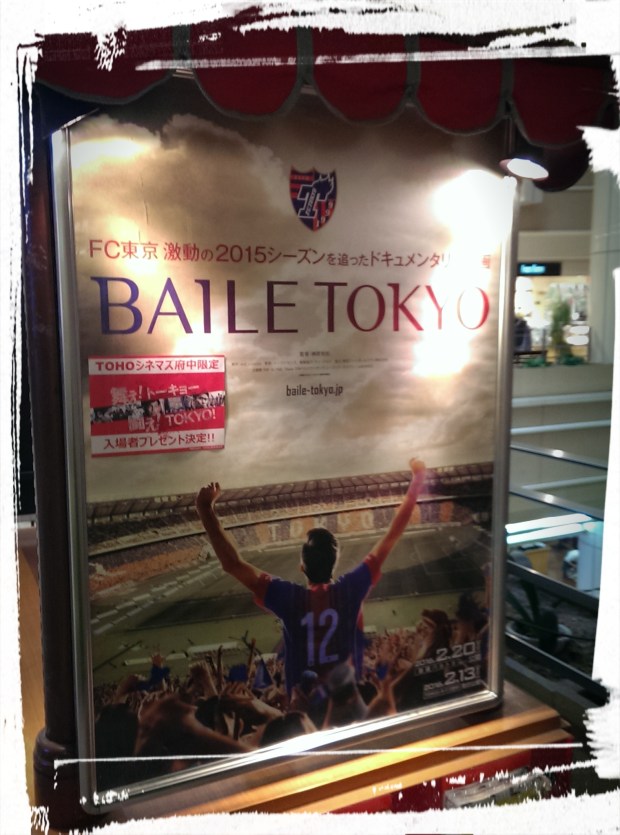
IMG_20160221_163133Film review, February 21, Tokyo – Bring a football team from the nation’s capital and a movie production team of club fans together and you get a documentary. Simple? Not really. “Baile Tokyo – Weaving the History” was shot over the 2015 J-League season to tell the story of the ups and downs of a year that promised so much but delivered too little.

Followers will remember the early euphoria from sitting joint top with Urawa in the early part of the 2-stage format competition, the mixed farewell to striker Yoshinori Muto’s mid-season departure to Mainz, and the despair of the scoreless draw with Sagan Tosu on the last day of the season that left them short of a chance at the league’s top prize. Dedicated fans would also recall the season-ending away loss to Hiroshima in the Emperor’s cup semi-final.

Yusuke Sakakibara’s first full-length documentary speaks to fans and wannabes, drawing on the mutual affection amongst the players and with their fans. Mixing stock footage with press statements, casual conversations in relaxed settings, and the occasional training session, the to-and-fro disrupted attempts to create a coherent message but combined well to tell the story behind an up-and-down season.

Documentaries normally focus on characters or themes to build stories around them. Sakakibara chose to shine the spotlight on a select group of several persons in and around the team. Players, officials, supporters were covered along with the club physio, in a sub-narrative of a battle for fitness after injury, a topic that is often said but not necessarily properly portrayed as part and parcel of sport. Officials were roped in to clarify the club’s ambitions – bring Tokyo to the top of Japanese and Asian soccer – even though they admit that the team hasn’t won the domestic title.

On the business side of things, it tried to scratch the surface of fanbase growth and media coverage. Japan’s capital has a broad, vibrant population that has the potential to bring in massive turnstile receipts. Indeed, FC Tokyo boasts an attendance of 28,000 per home game, second only to the fanatical Urawa Reds support, but this intake hardly fills even three quarters of its 50,000-seater Ajinomoto Stadium. Half-hearted media coverage and mediocre performances had promised to change with the prolific Muto, but he left midway, as the film reminds us.

Football fans often rankle and fume about how their team lost, was unjustly penalized, and feel joy at a lucky escape and pride at a well-earned win. Involvement is emotionally charged, whether in the stadium or off it. The documentary did well to paint sentimental farewells to fond faces, most notably Muto and Kosuke Ota. The emotional roller coaster ride is probably its best part, so fans have been warned – bring your tissues.

Overall, the film echoed the club’s ride in 2015, opening with promise and trying to end on a positive, forward-looking message, by mentioning its new B team’s participation in J3, Japan’s third tier. So it was half-expected to run out of time, or steam like the team did in 2015, and viewers are left with the choice of leaving their memories of 2015 at the cinema or continue writing the next chapter of FC Tokyo’s history together with the club in the new J1 season, starting on February 27.


“Baile Tokyo – Weaving the History” is directed by Yusuke Sakakibara. Opened on 20 February (Sat.) at 19 theaters across Japan, including Toho cineplexes in Fuchu, Odaiba, Shibuya, Shinjuku, and Yokohama. Fuchu Toho cinemas opened for prescreening on 13 February and is giving out 3 special edition movie postcards per viewer while stocks last.

Official website (in Japanese only): http://baile-tokyo.jp

Economic indicators for happiness?


Book review, Tokyo – What does it mean to be economical? Does it mean living within one’s means? Prudence probably sums that up better. What about only using what we need? That’s being frugal. Maybe being economical is about getting our money’s worth, and economics about efficient distribution of limited resources. Time is money, goes the old adage. So who’s measuring how we use our time for something worthwhile?

Modern life is about being tied, to loans, debt and feeding the ravenous monster that is the world economy. Countries chase numbers to pull in money for growth and indicators, to make sure the huge monster stays happy. Have we taken the time to stop and think about how happy we are as a cog in this unstoppable machinery?

Is it surprising that a picture book with a profound message that is more than 5 years old strikes more than a simple chord with someone in finance? The speaker, a former guerilla fighter, also happened to be the simple, frugal former head of state of a nation once known as the Switzerland of the Southern hemisphere, who featured in a series of Japanese books. Before these two picture books by Chobunsha, how the two languages sounded was the most obvious link between the two countries. The books created a new one, the ideas of former Uruguayan President Jose “Pepe” Mujica.

The first picture book released in 2014 vividly illustrated the then president’s simple, frank Rio+20 speech of his view on the state of human civilization. Lives misled by the demons of desire that end unfulfilled, saddled and ultimately crippled by debt. He proposes a rethink of our goals, our lifestyles at the fundamentals of modern society. He was content with his, tending to his vegetables, chickens, and refusing his official ride but indulging in a simple daily dose of tea. Acknowledging the importance of work to society, he leaves hints to being content and happy. His message that day still rings strong in Japan and recently Taiwan, and on Youtube, in the world’s search for sustainability.

The second book, a follow-up nearly 18 months later, is a longer, deeper look at the story behind the man who made that speech. Compiled from years of speeches and an interview after he was relieved of his stately duties, the book brings readers on a journey through his past as a guerilla fighter, the things, books and people, that changed him, and his thoughts on the future that we can fight to create.

The second book specifically mentioned Asia, hinting at the value of Asian teachings. By doing so, he seems to suggest that, when the time comes, Asia and its values would promise a chance to move the world in a new direction, toward a new type of life.

The illustrations and stories in these books are targeted at children, but the ideas are ones that adults relate more easily to. These books invite reflection and interaction, to discuss and find a way forward. It found success in Japan with a thoughtful population seeking escape in a time of a pro-growth national policy. So why not in other societies or markets that chase the same lofty highs? The language is the first barrier, the unconventional ideas are the next. Hopefully, we will get to see these books in English, preferably sooner rather than later. Otherwise, we’ll all have to depend on the Japanese and Chinese to work on finding happiness together.

“Sekai ichiban mazushii daitouryou no supiichi (A speech by the world’s poorest president)” was later translated into traditional Chinese as “Quan shijie zuiqiong de yeye lai yanjiang” by RuHe publishing. “Sekai ichiban mazushii daitouryou kara kimi he (A message from the world’s poorest president)” was released in October 2015 in Japan.

Publisher Jp:

  1. http://www.choubunsha.com/sp/book/9784811320670.php
  2. http://www.choubunsha.com/sp/book/9784811322483.php

e-commerce Tw: http://www.books.com.tw/products/0010689941

(Removed) J-Lit Center En

(Added) Retailer Kr:
http://www.kyobobook.co.kr/product/detailViewKor.laf?barcode=9791156130628

(Added) Publisher En:
The World’s Poorest President Speaks Out
Enchanted Lion Books, 2020

Tokyo’s looking at diversity


Tokyo, 12 November – Last week, Japan’s Ministry of Health, Labour and Welfare released its latest survey on the diversity of working arrangements in Japan’s shrinking population. For the first time in the survey’s history, non-perm or temp workers account for exactly 40.0% of the national workforce. Initial media reports highlighted the record, albeit slightly suspicious, ratio and a stunning statistic that many temps preferred the flexible working hours that part-time, temporary, and contract assignments offer. Unlike the survey, reports did not highlight the diversity in the temp workforce, a grouping of part-timers, full-time contract workers, and retiree rehires.

Part-timers, as the term suggests, work differently than other temps. For example, female part-timers, a third of temp respondents, were the main breadwinners less than 25% of the time, which means 75% were out there for the sake of pocket money. So part-timers choose when they lined their pockets while other temps looked for hard money and a job-skills fit even as they knew that the dearth of perm opportunities kept them swimming around the temp pool.

Meanwhile, close to 95% of male retiree rehires were still breadwinners making that smooth cost-heavy transition into full retirement. For younger temps, about 80% of men between ages 24-45 were breadwinners as compared to below 30% of women. So, temp or not, men in Japan still bring home the dough. Note that this age band is home to new and future families and parents.

Temps were also much less satisfied than perms about remuneration, job stability, and career prospects. On the other hand, perms were marginally unhappier with the quality of instruction from their managers and their working hours. Japanese work culture is infamous for long hours, and they don’t seem any more pro-family or pro-baby than the boomer years, so who will be there to power any future growth? With companies already turning to contracts to rehire retirees of proven value, it looks like even longer work hours and active aging for everyone.

Maybe a longer working life could translate into longer-term, sustainable growth, targets of Japan’s new stewardship and corporate codes. Before those two came around, Japan also changed its employment contract laws. They slapped a 5-year limit on dated contracts. Beyond that, a worker had the power to issue an ultimatum to convert to a rolling deal. This power came at a price – the law only applies to dates after promulgation. No backdating, slates wiped clean, employment contracts renewed from zero.

The law was devised to bring stability to contracted work, but if Japan’s economy were to grow again, as its government envisions, then the power to switch to a rolling contract on, most probably, a frozen wage will only slowly squeeze a temp’s already thin pockets. Some lawyers have commented on this no-win situation for temps. Companies are now free to estimate long-term temp costs using 5-year ceilings. No need to mention “black” companies, a growing social problem of employee exploitation, temp or otherwise.

Who can make things better? Activist investors are more of the latter, so since cheap, skilled labour is a win-win, don’t expect an agent of change there. What about employers? Do they have the principles or pockets to take valued temps on their permanent payroll? Or would they force them out? Maybe even deprive them of CV-pretty work ahead of the 35-year-old glass ceiling for jumping ship or before the temp-to-perm window arrives? The ball has been placed firmly in the hands of employers. Some temp agencies have switched to directly hiring registered persons as full-time ready to go employees, so there is new hope.

The flip side of this employment conundrum is the 60% perm workforce, where the temp-perm disparity could breed elements that are even less motivated toward productivity. Stability in the perm world can easily be twisted into protecting the system, scraping through with the bare minimum, and producing the goods only when a chance to climb up the corporate ladder comes round.

Toxic for productivity? No rocket growth, just inching up or down every year? Maybe that’s sustainable for a while. Now the case is for the entire workforce to be included in the numbers game, or a respected bastion of moral authority, like Justice Bao or Mito Komon, to ruffle some feathers and clean up the show, because it’s high time companies show some real commitment toward embracing diversity.

The little red dot gets a green stamp


From Tokyo, 11 July – Singapore is sometimes referred to as the little red dot, the way the island nation is usually indicated on the world map. The red dot now has acquired a new greenish tinge after gaining a green international stamp of recognition on 4 July. As recently as early 2012, the island nation had yet to ratify the UNESCO convention, but three years on, it has joined the list of cities that are home to a world heritage site.

The Singapore Botanical Gardens does not immediately strike me as even a national heritage, much less the world’s. A vast stretch of tropical green on the outskirts of Orchard Road, the garden city’s prime shopping district, the lack of foliage over its open areas can sometimes be forbidding in the perennial equatorial heat. Add the threat of marauding mosquito squadrons and the park becomes the abode of those ready to brave the conditions in search of free public space that offers the tranquil of nature in a concrete jungle. Many come prepared, glazed with the necessary repellants and armed with tools to beat the heat.

Foggy memories of a handful of visits often bring to mind tourists and expats with children in tow quietly admiring the lush vegetation, contrasted by school excursions in sweltering heat and chatty children rushing past the weeping willow and towering trees along the path. On weekends, the open grounds are often dotted by families and gatherings of foreign workers camped out on the slopes facing the Symphony Stage, sometimes treated to an evening of live relaxing music under the stars.

A public park is the image that first comes to mind. Not especially accessible and not a very generous selection of urban comforts. A landmark that’s been there since who knows when, is another. Today, it faces a high-profile local rival in the Gardens by the Bay. The heritage Gardens are immediately recognizable but it lacked depth in the collective memory, so it was no surprise that the government agencies sought to raise public awareness in a hark back to the years when the nation was known as “campaign country”.

The campaigns would have benefited public support and national pride, but the treasures and the park’s natural gems uncovered by the people closest to the nomination dossier remain unapparent to the broader citizenry. A race through the history of the national landmark on the Internet left many gray areas. Contrast this with a recently re-aired NHK documentary on an ongoing 150-year experiment that is the manmade forest around the Meiji Shrine in Tokyo. Well-documented and persuasively written, as a viewer I witnessed the experiment, shared the vision and eventually found myself living the dream of creating a self-sustaining forest in urban Tokyo. Singapore’s national media would do well to consider a careful trek through the Garden’s archives and staff to uncover the paths to secrets and stories surrounding the country’s latest global landmark.

The Gardens itself faces many challenges, in presenting its past, living the present and building for the future. Will the ground’s history become plain to visiting eyes? Will people recognize the trees that are more than a century old? Hitachi’s iconic centurion raintree, a species indigenous to the region, draws thousands of Japanese tourists to the Moanalua Gardens in Honolulu every year. How will it ensure that it links with the population and creates new common memory? Will the Gardens grow as an institution for botanic research in tie-ups with local and regional bodies? Budding green thumbs like myself would be looking for some home gardening tips, or practical herb use or cooking courses from a herbarium with big ambitions. A current course covers local plants and their use in Malay food, a promising connection to regional culture and society. The economic gardens could hold hints from the past for the way forward. I, for one, will expect more when its new online registration portal is up and running.

The Gardens probably recognize the work lined up ahead to turn Singapore “from a garden city into a city in a garden”, and it would definitely help to provide more accessible outreach and practical programs, link the people closer to nature and create more space for tired city eyes and souls. This green stamp of approval must give it the impetus and receive the support it deserves.

Singapore Botanical Gardens
https://www.sbg.org.sg/

Strong shift in force @Roppongi to Hokkaido and 18 December


Tokyo, 28 June – Darth Vader and the storm troopers at the Star Wars Visions will be packing up their set up at Roppongi Hills later today to quell cooler climes in Hokkaido. I managed to catch up with them a fortnight ago.

Making the quick trek up the spiral staircase past a queue for a rival exhibit (Naruto), I noticed that the lines were marked clearly with yellow masking tape. The Empire awaited along the middle path, before which a darkened indoor ticketing hall took in credits for entry. The steady stream of expectant fans were greeted by welcome signage overhead and a peek of the Death Star model and storm troopers taking aim at would-be trespassers.

Walking around the wall, I was greeted by who else but Vader himself in his meditation chamber. Standing silently, masked and plotting his next move as the soon-to-be-completed Death Star witnessed X-Wing duelling a smattering of the Empire’s fleet in a delay raid. New entrants were forced to bear with his theme song echoing across the hall, but the illusion of the enormity of facing an entire trooper platoon vanished at the mere sight of their posters adorning the glass panels above.

Eager ones lined up to pose with the protagonist, who stayed behind his iconic mask, while others shuffled along through the next portal to meet beings from other worlds. The visions were split into 6 sections – the original vision, the force, battles, sagas, the galaxy and droids. Inspirations for the saga led to the realization of the existence of the force, and then its two sides.

Fan art was coupled by a cast of retired weapons and bodies from the entire galaxy far, far away. Bubba Fett’s blaster, Jedi and Sith light sabres, mini models of the Jedi Council building and memorable battle scenes treated new and learned fans alike. Techie wannabes would have enjoyed the specs on the X-Wing, A-Wing and other vessels on display, while hitchikers could let their mind wonder across the worlds in a map of the entire galaxy.

Master Yoda stood quietly beside Amidala’s flowing white cloak, while the wirings of Vader’s mask lay open for all to see. Jabba the Hutt was there, the blue female alien dancer too, plus Ewoks and the bust of Chewbacca. The most impressive centerpiece was Hans Solo in cryogenic freeze. The stellar cast included the all-important droids, eventually the turning points in the saga, and a brilliantly gold C-3PO standing by to wave goodbye to a queue treated to tidbits from edited saga footage as they shuffled toward the store.

Of course, the chance to battle the man himself at the top of Roppongi Hills for just 500 yen and an image to last many lifetimes is surely the curtain-call poser. That is, before we say hello again to the galaxy come December 18 when the force awakens worldwide.

Star Wars Visions at Roppongi Tokyo City View
http://www.roppongihills.com/tcv/jp/sw-visions/

Staying on top with a book


Tokyo, 5 June – The Japanese Women’s national football team are enjoying a golden era. Sitting pretty atop the world since 2011, they went on to narrowly miss out on the 2012 London Olympics gold, but bounced back to win the last edition of the Asian prize in 2014. Nicknamed Nadeshiko Japan, the former a Japanese variety of the carnation and a synonym for reserved resilience in Japanese women, the team have had a few wobbles in their run-up to the 2015 Women’s World Cup starting tomorrow. Off the pitch, preparations to consolidate themselves at the top of the game have already gained ground in Japan.

My interest in football and children’s content drew me to this book a few months back, waiting quietly amidst the Doraemon corner of a bookstore. (Take a quick peek inside at: http://sample.shogakukan.co.jp/bv?isbn=9784092538573)

Pulling it out of the pile, straightaway the words on the cover struck me – for girls and boys alike! The order was clear, the target pretty high. Doraemon fans would be quick to realize that Shizuka has some innate sporting ability (when she did a body swap with Nobita and played a blinder in a baseball game), but the book goes beyond that by bringing in a new girl classmate. And guess what, that girl is an expert in football.

The book brings the usual suspects through a journey of learning the basics, from passing, heading, trapping and dribbling littered with rather blunt jokes by the willing cast. Besides the story, the book doubles, or rather it’s primary purpose is, as a quick intro to the rules of the game. It goes further, describing mini-games and drills to do with friends or alone. Moving through awareness of team mates and passing to tackling dribbling in the latter pages, the editors obviously recognize the difficulty and skill involved to maintain reader interest as she/he developed. A Shizuka-chan mini-series runs inside too, where she goes through some exercises to familiarize with the ball. The target can’t be any more clearer, and as a parent that would gladly take his children to a game, the idea certainly sold very quickly.

In my everyday routine, I’ve noticed many children’s football teams in Japan, and all-girl teams are not uncommon. The supervisors of this book, the Japan Football Association, obviously recognizes that for girls to develop their game, they have to play with their friends, and that often means playing among the boys, as did Homare Sawa, Japan’s most capped women’s player.

She’s no longer the captain, but still a highly influential figure on and off the pitch. The Japanese team is simply a joy to watch. They pass, link up and use the occasional dribble and feint to create and find space for team mates to capitalize. Not the most physical team around, their work and organization as a team are excellent. However, their recent string of successes seems to created some pressure, but the media have been very supportive, unlike their often scathing coverage of the men’s team. With such warm support and a book like this to help unearth and nurture new generations, I sure hope we get to enjoy this brand of football at the highest level in years to come!

『ドラえもんのスポーツおもしろ攻略 サッカーが楽しくできる』
(Doraemon Fun Sports Guides – Enjoy Soccer)
Shogakukan, Dec. 2013, 850 yen + tax
(http://www.shogakukan.co.jp/books/09253857)

Japanese reimport


Who is this masked cat?

Who is this masked cat?

From Tokyo to Singapore, 2 May – This is a tale of a reimport from Japan. It began one fine day in April, when a colleague asked whether I had heard of “The Tiramisu Hero”, since they apparently hailed from Singapore. Flabbergasted at another head-shaking, hand-flapping display of my utter lack of knowledge about developments back home, I held on frantically to the only hot lead – it was wildly popular in Japan.

Dr. Google told me that the traditional Italian dessert was being sold by a Zorro-masked cat on Rakuten, a major e-commerce portal in Japan. It had it’s own page, and a virtual queue of a lengthy 4 months. One post from a satisfied customer said it was simply worth the wait, which he/she almost forgot about, but that was balanced by others saying that they had ordered a month ago and were still waiting, or that they would have preferred if the store provided a delivery date. That’s something customers would expect from online on-demand sales, especially with hotter weather and vacation season coming our way.

Further digging revealed that the store began with an online presence before a real cafe opened in Oct 2013 in Singapore. 3 months later, they began making their rounds in major malls in Japan.

Sir Antonio's playground

Sir Antonio’s playground

I decided to unmask the cat by venturing into its den. I found it right next to the Lions’, by which I mean the spiritual home of the Singapore national football team in Jalan Besar. The Tiramisu Hero cafe stood right across the street. Accompanied by ready eaters, I strolled past the grass porch and the tables set outside to the air-conditioned abode of the cat and its desserts.

My eyes were immediately drawn to the internal deco. A larger-than-life head of Sir Antonio, the name of the cat as I later found out, ladders were everywhere, standing on the ceiling above, lying on it, and one that stood from ceiling to floor. Sir Antonio adorned the entire cafe, flying above, hiding in space, caressing corners, posing in costumes, as he welcomed visitors to his impressively doodled lair. The signature mask and moustache were soon imprinted in the minds of visitors.

Sat down at the table, I checked out the menu. Littered with cute illustrations that teased your imagination of how the dish would be presented, our eyes fed on main course options from fish and chips to fresh pasta and familiar sides like mushroom soup, garlic bread and fries. Standard western fare.

More creamy than chunky, but great garlic side!

More creamy than chunky, great side!

Crispy, juicy fish and chips

Crispy, juicy fish and chips

We ordered a conservative selection of chunky mushroom soup, fish and chips, aglio olio (angelhair pasta) and savoury creamy salmon. Of course, that was rounded off with tiramisu, brownies and mud pies. A brownie came with each set, but for some reason, some were replaced with fluffier fudge-glazed chunks that tasted like carrot cake, which were still yummy but off-menu. The swap was never explained but we paying customers didn’t either, as we half-enjoyed the surprise. The mud pie was plain sinful indulgence.

Plain indulgence

Plain indulgence

The bits of food were solid, not fantastic. The mushroom soup was more creamy than chunky, while the garlic bread on the side was superb, crisp and full of flavour. That said, our selection was especially garlicky. Aglio olio was simply overpowered by the delicious bulb. Accented by bacon bits and other spices, the angelhair simply didn’t figure other than to keep the pieces together. The fish and chips were crisp and juicy, and the expertly done salmon was accompanied by sticks of asparagus. All very nicely presented, but the greens tasted thick and unshaven. Picky eaters would probably have shunned it at first sight.

Buon appetito!

Enjoy it like so… Buon appetito!

Peering from under the covers?

Peering from under the covers?

Finally it was rounded off with the cafe’s namesake dessert. Original or Bailey’s, milo, kaya, durian even. Spoilt for choice and making the mistake of ordering our fixes after the meal, we had to settle for the first two. Served in cute glass bottles with Sir Antonio in various poses, the brown paperbag cover over the tin cap identified the liquid used within. All that just waiting to be opened and a spoon to sink into. Sir Antonio is a true hero of eye and mouth candy.

Aww.... goodbye for now

Goodbye for now

Open 11am-10pm

Budget: Around S$25 per person

Location: Shophouse opposite the hawker center at Jalan Besar Stadium

Seats: About 25 with Sir Antonio inside and another 10 without

AnimeJapan 2015


The crowd awaits

Where’s the crowd?

Tokyo, 22 March – Sun shining, temperatures poised to hit the twenties, and the occasional cloud in the sky set the stage for a perfect day out. Japan’s largest anime exhibition, AnimeJapan 2015, beckoned at Tokyo Big Sight at Ariake in the Tokyo bay area. The crowd streamed steadily from Kokusaitenjijo seimon mae station toward the iconic exhibition hall. Greeted by a poster signboard that directed the stream off to the walkway that seemed to wrap round the building, regular visitors were taken to a parking lot behind, while some privileged few, probably press or event sponsors, passed through open covered transparent walkways. The crowd seemed happy to create a line, with only a few voices to guide them at random intervals. All the way, there was excited chatter about characters, stories and upcoming titles that were supposedly unveiled a few days earlier.

That's some costume

That’s some costume

This was the anime crowd – a mixed bag of mid-20s to 40s, maybe even 50s, presumably either studying or employed. Some brought along family and were allowed in through a separate side route that took the kids away from the main crowd. They sauntered unhindered past the larger part of the anime following that quickly filled 2 separate parking lots, which together easily spanned a football pitch. The waiting areas were fenced in and dissected by a road, yet the crowd did not feel the least penned in or dampened. The cool weather and light breeze made the 20-minute walk and subsequent 40-minute wait a time to quickly catch up on topics and highlights for the day. Who would have thought that the cosplayer’s area would be within literally touching distance as we moved closer to the entrance to the exhibition hall? Press and excited fans busily worked their shutters, training their devices on others dressed in full costume. While others seemed adamant to revel in their skin, one did not leave any exposed. Such was the dedication to detail, an expression of extreme affinity comprehensible only as fandom. Not a cloud in the sky, there was no reason to stay outside when everyone else was raring to catch whatever awaited within.

The well-trained approach shot

The shutterbug’s approach shot

Two large halls split exhibitors, which were production studios, publishers, gaming companies and anime schools. Broadly familiar characters like Detective Conan and Pikachu floated above the booths below, echoing their elevated status in the industry. The floor was littered with dressed up girls, often the target of eager shutterbugs, dealing out freebies and pamphlets while similarly costumed fans strolled purposefully past to their mecca.

All too familiar faces galore

All too familiar faces galore

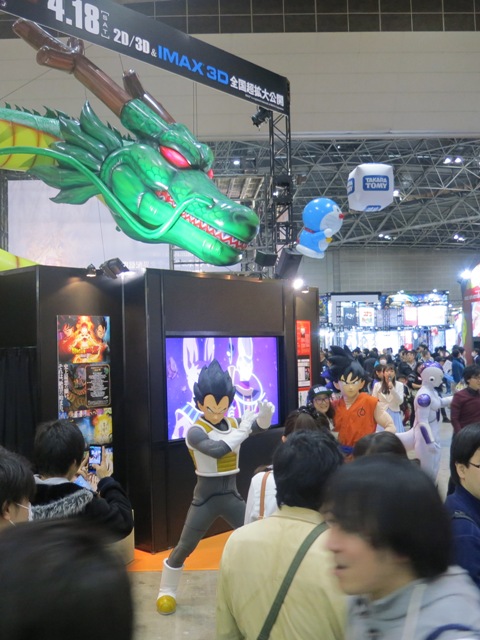
Besides the icons overhead, the uninitiated would find little difficulty in recognizing some familiar faces. Doraemon is celebrating its 35th year, while Dragon Ball had Frieza and Goku posing with fans for a new movie and Sailor Moon sat quietly in the same section of the hall. Cowboy Beebop placards peered over passerbys and Gundam teased fans with a three screen 270 degree enclosure of the upcoming movie trailer.

A stunning rendition of the entrance building

A stunning rendition of the entrance building

The Yoyogi Animation Gakuin booth left a largely different impression. Two artisans were at work that day, one sculpting clay figurines and the other painting. Both performers were screened in their mini live studios in monitors above as onlookers stayed peeled on the creative work in action. The brushwork piece from the day before was a stunning rendition of the iconic entrance building overcome by nature. Next door was the charity auction area where visitors could choose to donate and bid for the right to be drawn next to their favourite character or purchase limited edition memorabilia.

Soft clay mashables

Soft clay mashables

The subdued side of things

Enter the subdued family side of things

In contrast to the frenzy and excitement was an unusually subdued section across the hall. The view from this side into the family exhibit area left me confounded. Kids were usually the most easily heard by miles, yet the atmosphere in that section was non-existent to say the least. Booths were sparsely spaced, the few participant families littering the booths made the area even seem distinctly more vast. Primary school children and below were non-paying fans, but the contrast that day was embarrassingly obvious. The tables were turned, the targeted segment was clear.

Moving on to the next hall, the Japan Animators Exhibition showcased projects that attempted to push the limits of anime as a storytelling genre. Eyes were glued to a frantic man and bug story unfolding in an apartment interweaved with the bug taking on the form of screaming girl. Bizarre but wildly entertaining. It summed up the event for the uninitiated, with a few question marks hanging over using the event to cultivate the next generation of anime fans and would-be creators and storytellers. For that, the industry is well-equipped with other channels.