Kawasaki fights back to claim Tamagawa Classico


Tokyo, April 16 – The match between FC Tokyo and Kawasaki Frontale was set to be a mouth-watering matchup between the Japanese national team’s first choice center back pairing of Morishige and Maruyama against a free-flowing attacking side led by the league’s record scorer Yoshito Okubo. Okubo had rewritten the history books by overtaking Gon Nakayama’s record haul of 158 goals in the Japanese league and seemed ready to oblige with some more.

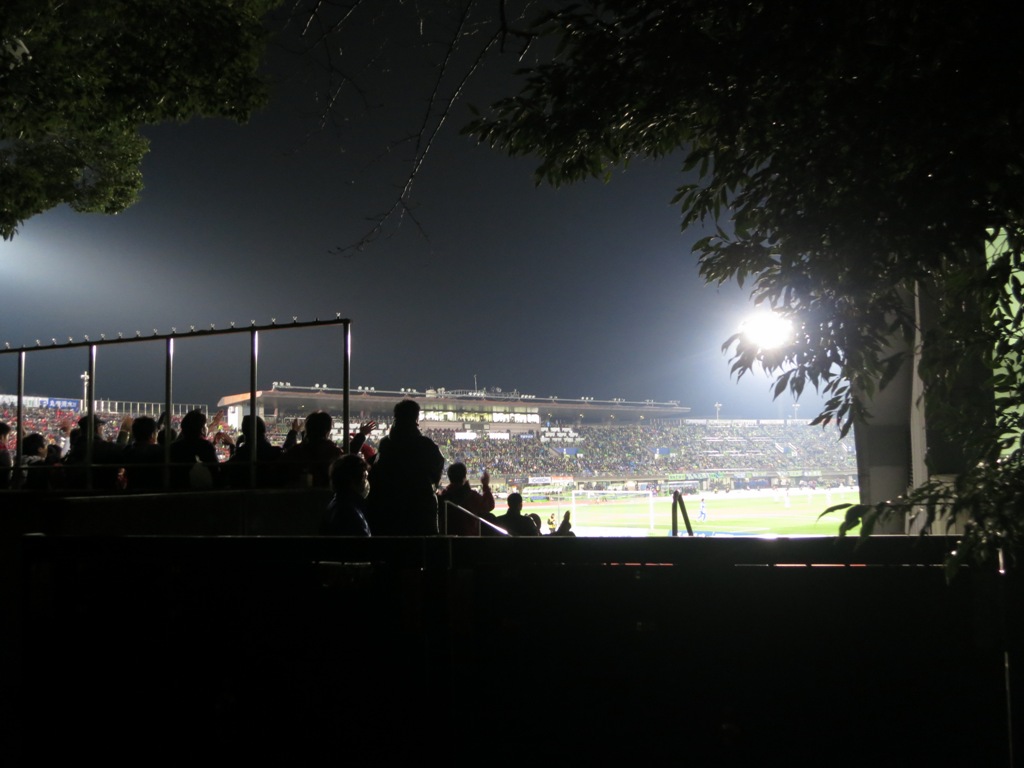
The atmosphere was electric with almost 30,000 cheering on their teams in the Tamagawa Classico, named after the river that flows alongside their fan bases.

IMG_20160418_021236
FC Tokyo was set up to counter with Nathan Burns to drive directly at and exploit the space behind a notoriously porous Kawasaki backline. The tactic paid off quickly. Sotan Tanabe capitalized on some unsettled defending, and the ball bounced nicely toward Burns who sped away and drove it in for an early Tokyo lead.

The early goal sent the home supporters bouncing, but it didn’t last. Kawasaki struck seven minutes later, in the 11th minute, with two team stalwarts linking up. Kengo Nakamura directed a looping pass behind the Tokyo backline for Okubo to run onto. He shrugged off sideback Ogawa’s challenge, and blasted it in to take his tally to 160.

However, Kawasaki were unable to find any fluidity in their game and their attacks were constantly repelled before they could really threaten the goal by a combination of solid defending and good midfield cover. The on-looking national coach would have been pleased to see the quality of play at both ends of the pitch.

FC Tokyo were asking the questions. Burns had a hatful of chances to put FC Tokyo back ahead. He slid the ball wide from a carbon copy opening, and when Maeda teed him up in a central position in the penalty area, he ended up shooting wide. Kawasaki rode their luck when he headed a Ha Dae Sung cross just over, and the teams ended the half level.

Kawasaki started the second half brightly, Okubo driving a long-range shot onto the crossbar. As the half wore on, World Cup final referee Nishmura exercised more control as tired legs made for more fouls and openings. FC Tokyo was let off the hook when Moritani seemed caught in two minds all alone after rounding the keeper. FC Tokyo then won a freekick near the Kawasaki penalty area. Ogawa drove in a dangerous low cross in behind the defensive line toward an onrushing Maeda who pounced from close range.

2-1, and FC Tokyo was ready to wrap up the game with half an hour to go. Burns linked up well with Maeda and Yonemoto but failed to create a 2-goal cushion. The crowd was instead treated to the guile of the master goalgetter. Okubo ran into the box and seemed ready to pull the trigger in front of a mass of bodies. But he faked a shot with his right foot, then as he repositioned the ball onto his left foot, he got caught by Yonemoto’s trailing leg. FC Tokyo fumed at the decision, but he had been caught in the box, and Nishimura chose to apply the rules to the letter. A soft award but a strong penalty driven gleefully down the center for no.161. The home fans were somewhat deflated but picked themselves up to sing “We can’t lose” in a bid to remind the players that the scores were still even.

With 15 minutes to play, FC Tokyo coach Jofuku sent on Muriki for a tiring Maeda to bring some trickery to the frontline. The change did little to stem the newfound Kawasaki rhythm, and the waves of attacks soon found an opening. Elsinho threaded a pinpoint pass through to Yu Kobayashi just beyond Tokunaga, who could not stop him or his rocket into the top corner. Kawasaki had fought back to lead 3-2.

Muriki could have tied the game, but his rushed shot went just wide. Tension crept into Tokyo’s game and it made them dally on good positions so half-openings slipped away.

Kawasaki were not done. Right to the end, they showed greater verve and made possession count. Kengo Nakamura raced down the flank and cut into the box and down the byline before finding Elsinho unmarked at the far post, who made no mistake. Record scorer Okubo lay on the ground at the final whistle and he ended up leaving the pitch on a stretcher, but FC Tokyo will have rued missed chances and a penalty that changed the complexion of the game.

Result: FC Tokyo 2-4 Kawasaki Frontale
FC Tokyo documentary invites viewers to co-write club’s history


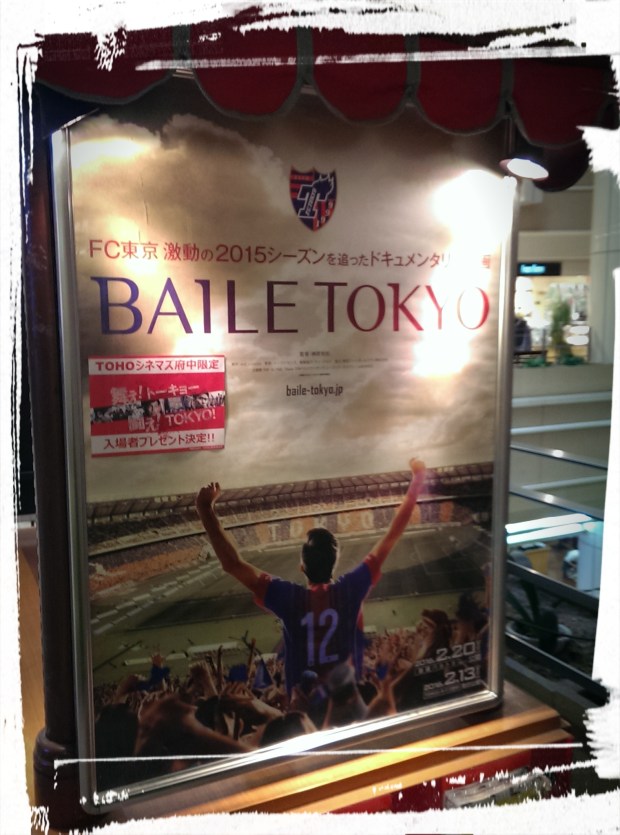
IMG_20160221_163133Film review, February 21, Tokyo – Bring a football team from the nation’s capital and a movie production team of club fans together and you get a documentary. Simple? Not really. “Baile Tokyo – Weaving the History” was shot over the 2015 J-League season to tell the story of the ups and downs of a year that promised so much but delivered too little.
Followers will remember the early euphoria from sitting joint top with Urawa in the early part of the 2-stage format competition, the mixed farewell to striker Yoshinori Muto’s mid-season departure to Mainz, and the despair of the scoreless draw with Sagan Tosu on the last day of the season that left them short of a chance at the league’s top prize. Dedicated fans would also recall the season-ending away loss to Hiroshima in the Emperor’s cup semi-final.

Yusuke Sakakibara’s first full-length documentary speaks to fans and wannabes, drawing on the mutual affection amongst the players and with their fans. Mixing stock footage with press statements, casual conversations in relaxed settings, and the occasional training session, the to-and-fro disrupted attempts to create a coherent message but combined well to tell the story behind an up-and-down season.

Documentaries normally focus on characters or themes to build stories around them. Sakakibara chose to shine the spotlight on a select group of several persons in and around the team. Players, officials, supporters were covered along with the club physio, in a sub-narrative of a battle for fitness after injury, a topic that is often said but not necessarily properly portrayed as part and parcel of sport. Officials were roped in to clarify the club’s ambitions – bring Tokyo to the top of Japanese and Asian soccer – even though they admit that the team hasn’t won the domestic title.

On the business side of things, it tried to scratch the surface of fanbase growth and media coverage. Japan’s capital has a broad, vibrant population that has the potential to bring in massive turnstile receipts. Indeed, FC Tokyo boasts an attendance of 28,000 per home game, second only to the fanatical Urawa Reds support, but this intake hardly fills even three quarters of its 50,000-seater Ajinomoto Stadium. Half-hearted media coverage and mediocre performances had promised to change with the prolific Muto, but he left midway, as the film reminds us.

Football fans often rankle and fume about how their team lost, was unjustly penalized, and feel joy at a lucky escape and pride at a well-earned win. Involvement is emotionally charged, whether in the stadium or off it. The documentary did well to paint sentimental farewells to fond faces, most notably Muto and Kosuke Ota. The emotional roller coaster ride is probably its best part, so fans have been warned – bring your tissues.

Overall, the film echoed the club’s ride in 2015, opening with promise and trying to end on a positive, forward-looking message, by mentioning its new B team’s participation in J3, Japan’s third tier. So it was half-expected to run out of time, or steam like the team did in 2015, and viewers are left with the choice of leaving their memories of 2015 at the cinema or continue writing the next chapter of FC Tokyo’s history together with the club in the new J1 season, starting on February 27.


“Baile Tokyo – Weaving the History” is directed by Yusuke Sakakibara. Opened on 20 February (Sat.) at 19 theaters across Japan, including Toho cineplexes in Fuchu, Odaiba, Shibuya, Shinjuku, and Yokohama. Fuchu Toho cinemas opened for prescreening on 13 February and is giving out 3 special edition movie postcards per viewer while stocks last.

Official website (in Japanese only): http://baile-tokyo.jp

Economic indicators for happiness?


Book review, Tokyo – What does it mean to be economical? Does it mean living within one’s means? Prudence probably sums that up better. What about only using what we need? That’s being frugal. Maybe being economical is about getting our money’s worth, and economics about efficient distribution of limited resources. Time is money, goes the old adage. So who’s measuring how we use our time for something worthwhile?

Modern life is about being tied, to loans, debt and feeding the ravenous monster that is the world economy. Countries chase numbers to pull in money for growth and indicators, to make sure the huge monster stays happy. Have we taken the time to stop and think about how happy we are as a cog in this unstoppable machinery?

Is it surprising that a picture book with a profound message that is more than 5 years old strikes more than a simple chord with someone in finance? The speaker, a former guerilla fighter, also happened to be the simple, frugal former head of state of a nation once known as the Switzerland of the Southern hemisphere, who featured in a series of Japanese books. Before these two picture books by Chobunsha, how the two languages sounded was the most obvious link between the two countries. The books created a new one, the ideas of former Uruguayan President Jose “Pepe” Mujica.

The first picture book released in 2014 vividly illustrated the then president’s simple, frank Rio+20 speech of his view on the state of human civilization. Lives misled by the demons of desire that end unfulfilled, saddled and ultimately crippled by debt. He proposes a rethink of our goals, our lifestyles at the fundamentals of modern society. He was content with his, tending to his vegetables, chickens, and refusing his official ride but indulging in a simple daily dose of tea. Acknowledging the importance of work to society, he leaves hints to being content and happy. His message that day still rings strong in Japan and recently Taiwan, and on Youtube, in the world’s search for sustainability.

The second book, a follow-up nearly 18 months later, is a longer, deeper look at the story behind the man who made that speech. Compiled from years of speeches and an interview after he was relieved of his stately duties, the book brings readers on a journey through his past as a guerilla fighter, the things, books and people, that changed him, and his thoughts on the future that we can fight to create.

The second book specifically mentioned Asia, hinting at the value of Asian teachings. By doing so, he seems to suggest that, when the time comes, Asia and its values would promise a chance to move the world in a new direction, toward a new type of life.

The illustrations and stories in these books are targeted at children, but the ideas are ones that adults relate more easily to. These books invite reflection and interaction, to discuss and find a way forward. It found success in Japan with a thoughtful population seeking escape in a time of a pro-growth national policy. So why not in other societies or markets that chase the same lofty highs? The language is the first barrier, the unconventional ideas are the next. Hopefully, we will get to see these books in English, preferably sooner rather than later. Otherwise, we’ll all have to depend on the Japanese and Chinese to work on finding happiness together.

“Sekai ichiban mazushii daitouryou no supiichi (A speech by the world’s poorest president)” was later translated into traditional Chinese as “Quan shijie zuiqiong de yeye lai yanjiang” by RuHe publishing. “Sekai ichiban mazushii daitouryou kara kimi he (A message from the world’s poorest president)” was released in October 2015 in Japan.

Publisher Jp:

  1. http://www.choubunsha.com/sp/book/9784811320670.php
  2. http://www.choubunsha.com/sp/book/9784811322483.php

e-commerce Tw: http://www.books.com.tw/products/0010689941

(Removed) J-Lit Center En

(Added) Retailer Kr:
http://www.kyobobook.co.kr/product/detailViewKor.laf?barcode=9791156130628

(Added) Publisher En:
The World’s Poorest President Speaks Out
Enchanted Lion Books, 2020

Strong shift in force @Roppongi to Hokkaido and 18 December


Tokyo, 28 June – Darth Vader and the storm troopers at the Star Wars Visions will be packing up their set up at Roppongi Hills later today to quell cooler climes in Hokkaido. I managed to catch up with them a fortnight ago.

Making the quick trek up the spiral staircase past a queue for a rival exhibit (Naruto), I noticed that the lines were marked clearly with yellow masking tape. The Empire awaited along the middle path, before which a darkened indoor ticketing hall took in credits for entry. The steady stream of expectant fans were greeted by welcome signage overhead and a peek of the Death Star model and storm troopers taking aim at would-be trespassers.

Walking around the wall, I was greeted by who else but Vader himself in his meditation chamber. Standing silently, masked and plotting his next move as the soon-to-be-completed Death Star witnessed X-Wing duelling a smattering of the Empire’s fleet in a delay raid. New entrants were forced to bear with his theme song echoing across the hall, but the illusion of the enormity of facing an entire trooper platoon vanished at the mere sight of their posters adorning the glass panels above.

Eager ones lined up to pose with the protagonist, who stayed behind his iconic mask, while others shuffled along through the next portal to meet beings from other worlds. The visions were split into 6 sections – the original vision, the force, battles, sagas, the galaxy and droids. Inspirations for the saga led to the realization of the existence of the force, and then its two sides.

Fan art was coupled by a cast of retired weapons and bodies from the entire galaxy far, far away. Bubba Fett’s blaster, Jedi and Sith light sabres, mini models of the Jedi Council building and memorable battle scenes treated new and learned fans alike. Techie wannabes would have enjoyed the specs on the X-Wing, A-Wing and other vessels on display, while hitchikers could let their mind wonder across the worlds in a map of the entire galaxy.

Master Yoda stood quietly beside Amidala’s flowing white cloak, while the wirings of Vader’s mask lay open for all to see. Jabba the Hutt was there, the blue female alien dancer too, plus Ewoks and the bust of Chewbacca. The most impressive centerpiece was Hans Solo in cryogenic freeze. The stellar cast included the all-important droids, eventually the turning points in the saga, and a brilliantly gold C-3PO standing by to wave goodbye to a queue treated to tidbits from edited saga footage as they shuffled toward the store.

Of course, the chance to battle the man himself at the top of Roppongi Hills for just 500 yen and an image to last many lifetimes is surely the curtain-call poser. That is, before we say hello again to the galaxy come December 18 when the force awakens worldwide.

Star Wars Visions at Roppongi Tokyo City View
http://www.roppongihills.com/tcv/jp/sw-visions/

Staying on top with a book


Tokyo, 5 June – The Japanese Women’s national football team are enjoying a golden era. Sitting pretty atop the world since 2011, they went on to narrowly miss out on the 2012 London Olympics gold, but bounced back to win the last edition of the Asian prize in 2014. Nicknamed Nadeshiko Japan, the former a Japanese variety of the carnation and a synonym for reserved resilience in Japanese women, the team have had a few wobbles in their run-up to the 2015 Women’s World Cup starting tomorrow. Off the pitch, preparations to consolidate themselves at the top of the game have already gained ground in Japan.

My interest in football and children’s content drew me to this book a few months back, waiting quietly amidst the Doraemon corner of a bookstore. (Take a quick peek inside at: http://sample.shogakukan.co.jp/bv?isbn=9784092538573)

Pulling it out of the pile, straightaway the words on the cover struck me – for girls and boys alike! The order was clear, the target pretty high. Doraemon fans would be quick to realize that Shizuka has some innate sporting ability (when she did a body swap with Nobita and played a blinder in a baseball game), but the book goes beyond that by bringing in a new girl classmate. And guess what, that girl is an expert in football.

The book brings the usual suspects through a journey of learning the basics, from passing, heading, trapping and dribbling littered with rather blunt jokes by the willing cast. Besides the story, the book doubles, or rather it’s primary purpose is, as a quick intro to the rules of the game. It goes further, describing mini-games and drills to do with friends or alone. Moving through awareness of team mates and passing to tackling dribbling in the latter pages, the editors obviously recognize the difficulty and skill involved to maintain reader interest as she/he developed. A Shizuka-chan mini-series runs inside too, where she goes through some exercises to familiarize with the ball. The target can’t be any more clearer, and as a parent that would gladly take his children to a game, the idea certainly sold very quickly.

In my everyday routine, I’ve noticed many children’s football teams in Japan, and all-girl teams are not uncommon. The supervisors of this book, the Japan Football Association, obviously recognizes that for girls to develop their game, they have to play with their friends, and that often means playing among the boys, as did Homare Sawa, Japan’s most capped women’s player.

She’s no longer the captain, but still a highly influential figure on and off the pitch. The Japanese team is simply a joy to watch. They pass, link up and use the occasional dribble and feint to create and find space for team mates to capitalize. Not the most physical team around, their work and organization as a team are excellent. However, their recent string of successes seems to created some pressure, but the media have been very supportive, unlike their often scathing coverage of the men’s team. With such warm support and a book like this to help unearth and nurture new generations, I sure hope we get to enjoy this brand of football at the highest level in years to come!

『ドラえもんのスポーツおもしろ攻略 サッカーが楽しくできる』
(Doraemon Fun Sports Guides – Enjoy Soccer)
Shogakukan, Dec. 2013, 850 yen + tax
(http://www.shogakukan.co.jp/books/09253857)

AnimeJapan 2015


The crowd awaits

Where’s the crowd?

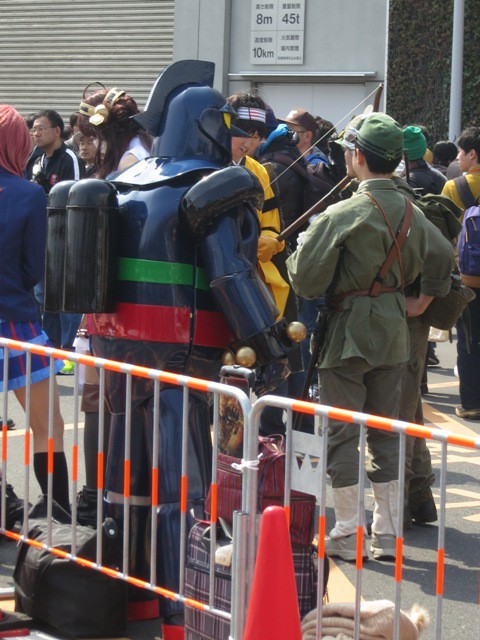
Tokyo, 22 March – Sun shining, temperatures poised to hit the twenties, and the occasional cloud in the sky set the stage for a perfect day out. Japan’s largest anime exhibition, AnimeJapan 2015, beckoned at Tokyo Big Sight at Ariake in the Tokyo bay area. The crowd streamed steadily from Kokusaitenjijo seimon mae station toward the iconic exhibition hall. Greeted by a poster signboard that directed the stream off to the walkway that seemed to wrap round the building, regular visitors were taken to a parking lot behind, while some privileged few, probably press or event sponsors, passed through open covered transparent walkways. The crowd seemed happy to create a line, with only a few voices to guide them at random intervals. All the way, there was excited chatter about characters, stories and upcoming titles that were supposedly unveiled a few days earlier.

That's some costume

That’s some costume

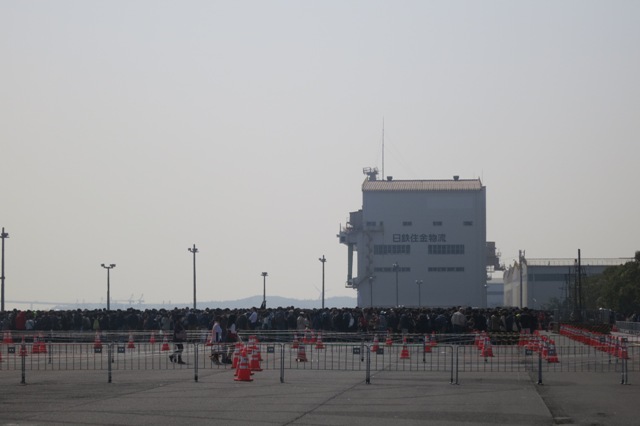
This was the anime crowd – a mixed bag of mid-20s to 40s, maybe even 50s, presumably either studying or employed. Some brought along family and were allowed in through a separate side route that took the kids away from the main crowd. They sauntered unhindered past the larger part of the anime following that quickly filled 2 separate parking lots, which together easily spanned a football pitch. The waiting areas were fenced in and dissected by a road, yet the crowd did not feel the least penned in or dampened. The cool weather and light breeze made the 20-minute walk and subsequent 40-minute wait a time to quickly catch up on topics and highlights for the day. Who would have thought that the cosplayer’s area would be within literally touching distance as we moved closer to the entrance to the exhibition hall? Press and excited fans busily worked their shutters, training their devices on others dressed in full costume. While others seemed adamant to revel in their skin, one did not leave any exposed. Such was the dedication to detail, an expression of extreme affinity comprehensible only as fandom. Not a cloud in the sky, there was no reason to stay outside when everyone else was raring to catch whatever awaited within.

The well-trained approach shot

The shutterbug’s approach shot

Two large halls split exhibitors, which were production studios, publishers, gaming companies and anime schools. Broadly familiar characters like Detective Conan and Pikachu floated above the booths below, echoing their elevated status in the industry. The floor was littered with dressed up girls, often the target of eager shutterbugs, dealing out freebies and pamphlets while similarly costumed fans strolled purposefully past to their mecca.

All too familiar faces galore

All too familiar faces galore

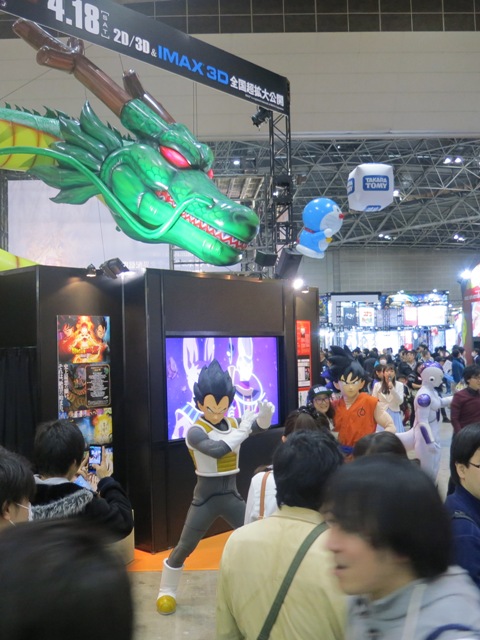
Besides the icons overhead, the uninitiated would find little difficulty in recognizing some familiar faces. Doraemon is celebrating its 35th year, while Dragon Ball had Frieza and Goku posing with fans for a new movie and Sailor Moon sat quietly in the same section of the hall. Cowboy Beebop placards peered over passerbys and Gundam teased fans with a three screen 270 degree enclosure of the upcoming movie trailer.

A stunning rendition of the entrance building

A stunning rendition of the entrance building

The Yoyogi Animation Gakuin booth left a largely different impression. Two artisans were at work that day, one sculpting clay figurines and the other painting. Both performers were screened in their mini live studios in monitors above as onlookers stayed peeled on the creative work in action. The brushwork piece from the day before was a stunning rendition of the iconic entrance building overcome by nature. Next door was the charity auction area where visitors could choose to donate and bid for the right to be drawn next to their favourite character or purchase limited edition memorabilia.

Soft clay mashables

Soft clay mashables

The subdued side of things

Enter the subdued family side of things

In contrast to the frenzy and excitement was an unusually subdued section across the hall. The view from this side into the family exhibit area left me confounded. Kids were usually the most easily heard by miles, yet the atmosphere in that section was non-existent to say the least. Booths were sparsely spaced, the few participant families littering the booths made the area even seem distinctly more vast. Primary school children and below were non-paying fans, but the contrast that day was embarrassingly obvious. The tables were turned, the targeted segment was clear.

Moving on to the next hall, the Japan Animators Exhibition showcased projects that attempted to push the limits of anime as a storytelling genre. Eyes were glued to a frantic man and bug story unfolding in an apartment interweaved with the bug taking on the form of screaming girl. Bizarre but wildly entertaining. It summed up the event for the uninitiated, with a few question marks hanging over using the event to cultivate the next generation of anime fans and would-be creators and storytellers. For that, the industry is well-equipped with other channels.

A flag and a legacy


Tokyo – I remember being surprised by flags one day as I came to the office. A crumpled one clinging to the post over the staff entrance left me wondering. It was slightly cloudy, trains were on time, I was at the office, and I was quite sure of the need to be there that day, even if it were only perfunctory. The flag failed to flutter but the black strip under it tied round the post did. Did someone important just die? It was March 11. Then it dawned on me.

Four years had passed since the tsunami struck northeast Japan. Today, Japan is in its best moment, riding on the pro-growth Abenomics rhetoric, and cherry blossom buds growing fuller. The prospects are good, but the lack of respect was startling. We all understand protocol and the need to observe events, but to do things properly should be at the root of all meaningful actions. Otherwise, it’s just not worth doing.

Flags are symbols that command respect, and desecration can, in most countries, have severe consequences. Japan is one surprising exception; desecration is implicitly covered in the Japanese Constitution under freedom of speech, that is, people are allowed to disrespect the Japanese national flag. No other law exists to prohibit it, yet foreign flags are protected under Japanese law.

Scant respect for its own drew scrutiny at lunchtime from a security guard, peering overhead to see what had happened. Someone had apparently failed to iron it, or simply took it too quickly out from the washer. At least it wasn’t dripping or visibly torn. There was a slight breeze, and anyone who noticed as they walked past would inevitably feel a sense of shame or indignity, if they cared.

I raised the problem to a friend. The word “shame” was mentioned softly as people around me kept it quiet. It seemed as though they wanted this day to pass without issue and for the flag to hang in plain public view undetected. From the security guard’s actions, they just didn’t bother to correct it or even consider improving the situation. Any act to adjust the flag that was already hoisted would be incriminating, so just leave it as a doubtful entanglement hanging off the building, and lower it at the end of the day. Besides, it would be worse to leave this one pole empty if it took hours to iron out the creases, wouldn’t it?

Painful, appalling inaction and disrespect – the flag PAID the price of someone who simply followed the book without observing its substance, and everyone else who did not bother to do anything to change it. That the flag was probably only seen by company employees and visitors was its only saving grace, for it, not the people.

Contrast this with the formal, organized State Funeral for Singapore’s founding Prime Minister, Mr. Lee Kuan Yew. The media covered every inch, foreign dignitaries flocked to pay respects, and the people were understandably very emotional. You could see the bias among certain circles against this seemingly well-drilled regime, but the organization and finesse of the communications to the public spoke volumes of the people, its institutions and its government. The week-long run-up even included a faked government website release announcing his death.

Soon celebrating its 50th anniversary without its visionary leader but left with a legacy of friendships and connections that span the globe from the founding generation, the final day’s eulogies reflected the spirit of the nation; it sets aside time to remember, but remains ever ready to move on. Singapore’s anthem urges progress, its pledge aspires to a harmonious, prosperous future. Recognizing the constant struggle to survive, the endless marathon to stay relevant, and the journey ahead, this young nation and its people understands its needs and is prepared to pull together to build a better future.

The nation’s economic miracle is a legacy for everyone. The guiding light is gone but continues to shine beyond its existence, allowing others to follow, draw upon and make it travel further. Anyone blighted with internal struggles, nonchalance, or indifference bordering on conceit, can turn to this legacy to remember the constant struggle, the sacrifices made and the path that was painstakingly laid in a bid to remain competitive and relevant. A new journey will soon begin, toward inclusive, sustainable progress. Those already overtaken should take heed.

Of sniffles and snides


Tokyo, 23 Mar – I woke up this morning feeling tired and restless. Bereft of any desire to get to work, my feet trudged across the wooden flooring as I went about the morning routine. They somehow took a body that was slowly getting into gear to the train platform, when the arm, a perfectly programmed extension of the body, reached into the trouser pocket to retrieve my phone.

The commuter routine began. Masked, foggy glasses, jam-packed trains, intermittent stops. All part of the morning ride. My fingers worked the screen swiftly, scourging the Internet for news. My mind was racing through topics of interest that required updating and relayed them to fire the synapses into action. They were stopped by the Channel NewsAsia headline – Mr. Lee Kuan Yew had passed away at 91 earlier at 3.18 am.

As my train arrived, I felt insecure, shaken and struck by melancholy sadness that was tinged with a heavy dose of admiration and relief. Every sniffle around me, every listless eye peering out at the scenery whizzing by seemed captured by sympathy. It was over.

The past few days had been a Facebook timeline of tributes and prayers for Singapore’s founding Prime Minister. Famous words, unforgettable scenes, touching sequences. They all drew a picture of the person behind the face that all Singaporeans, and perhaps many Malaysians too, had grown so accustomed to seeing ever so often. The write-ups painted a demanding leader, visionary and inspirational, but also frugal and sentimental. The public domain was soon filled with messages and outpouring of sympathies for Mr. Lee from the world over. The world had soon overwhelmed this little red dot and its people. A week of national mourning in Singapore was declared by Prime Minister Lee Hsien Loong, and going to work felt beyond me.

Yet by that time, my feet had already taken me past my transfer. I had scarcely anything to do besides meager tasks, but a subsequent inquiry revealed that the condolence books at overseas missions would not be open until the next day. They would remain so till the weekend to allow citizens and friends of Singapore to offer their condolences to Mr. Lee, the most influential Asian leader that I’ve lived under.

Just a few years back, he was still attending conferences and making trips across the world to cement Singapore’s position in the global arena. The tireless spirit has finally left its citizens with a huge void to fill and a legacy of a first class nation. The rise of this tiny island from a third world nation to the world’s third in per capita GDP is a story that will inspire generations to come.

As part of a largely non-English corporate propaganda churning unit, I was invariably tasked with drafting private letters to my fellow countrymen. Laughs turned to sniggers, sniffs sounded like snorts. Insensitivity is an understatement. A simple direct instruction was viewed as a blatant order to punish the eternally-contracted foreigner.

The public domain was already full of templates and expressions. A gathering of them would do the job perfectly, but the senses left my fingers as they clutched and clasped at my head, struggling to claw the right words out for someone else. The limbs worked, sometimes in a flurry, sometimes stationary. Three paragraphs settled, done, I left the office deflated and eager to find my own words.

I hope they will come to me in time, before my legs take me to the Embassy to stand before the condolence book ready to pen in my entry. My synapses and internal wiring would not be trusted to do a job that would end up entirely mechanical, devoid of emotion. I shall draw on my upbringing, education and childhood to express my gratitude, and then move on. Just like in Singapore, we stop, but only for a week to remember. Thank you Mr. Lee.

– updated 24 Mar

Dejavu@ Ajinomoto stadium – J-League 2015 Game 2 (14 March)


Chofu, Tokyo – FC Tokyo’s opening home game for the new season pitched them against the same team as last season’s final game. Just over 3 months since the 1-1 draw at Ajinomoto stadium, Yokohama Marinos were looking for their first points of the new campaign. Meanwhile, FC Tokyo had clawed back a point from last season’s treble winners, Gamba Osaka, when its suave young striker Yoshinori Muto completed his brace deep into stoppage time to send the travelling fans into ecstasy.

Fans streaming in an hour before kickoff

Fans streaming in an hour before kickoff

Tobitakyu station was filled with an expectant home crowd and similarly excited away fans. The away team clearly saw themselves as tricolour, while Tokyo was largely blue tinged with wine red. With both teams sporting similar team colours, the two sets of fans and their gear could only be discerned at close range as they made the mandatory 5-minute trek from the station. Of course, they also parted ways to move to opposite sides of the stadium. Incidentally, the away team were to sport their new gold away kit for this fixture.

Today's fixture

Today’s fixture

Opening home day fanfare lined up special guest, singer and actress Sakurako Ohara to rock the stands before kickoff and the Tokyo Girls Collection’s official Tokyo Girls Run team of runway runners on the pitch at half-time. A group was spotted sitting pitch-side throughout the game. These fans were owners of new special one-day tickets and accompanying authentic design collapsible chairs provided by kit sponsors Umbro. Open only to home supporters and coming with strict viewing conditions, excitement seemed to bubble from that part of the pitch, which was as close to the home goal as you could get.

Moving slowly through the crowd on the concourse

Moving slowly through the crowd on the concourse

The stadium concourse was packed with lines of hungry fans eager to grab a bite before the 2pm kickoff. Dorompa, Tokyo’s sporty raccoon dog mascot, could be seen everywhere, but the real one had its usual busy schedule of appearances in various locations. A Tokyo-only menu item taco-rice (rice topped with taco filling) had sold out early. Whether this had anything to do with taco meaning to draw a blank in Japanese, home fans were definitely hoping to see goals to build on last weekend’s result. The game was also to be a surprise first to be watched by Vahid Halilhodzic shortly after his official announcement as the new coach of the Japanese national team. The Bosnian had famously led Algeria to the last 16 round for the first time at the 2014 World Cup.

After the usual team announcements, the stadium aired a familiar tune – You’ll Never Walk Alone. The rendition of one of football’s most famous anthems by a largely Japanese home crowd, where the music tapers off midway, left a sombre and dignified tune filling the space between the two sets of fans – welcome to Tokyo and let the game begin.

Home fans in full song

Home fans in full song

The 30,000-strong crowd was slightly short of attendance at last season’s closer, nearly 32,600. Both sets of fans were left hanging on until the closing stages of the game in a solid tactical performance by both teams. Tokyo came nearest to goal twice in the first half while Yokohama were also culpable for failing to finish off clear chances. It was only late in the game that Tokyo seemed to change gears, as the visitors endured waves of attacks that just lacked the final pass. A sense of deflation seemed to linger after referee Yuichi Nishimura (yes, he who attracted worldwide attention in Brazil’s opening World Cup 2014 game against Croatia) blew the final whistle, and fans were left to reflect on lost chances and the dejavu of another draw from the same fixture.

– Result: FC Tokyo 0 Yokohama Marinos 0

A new beginning – J-League 2015 kickoff @ Hiratsuka (7 March)


Hiratsuka, Japan – With the day’s opening 2pm kickoffs out of the way, I ventured to the Shonan BMW stadium in Hiratsuka in search of the opening day revelry. As the sun set, I made my journey toward Isehara station, about an hour West of Shinjuku on the Odakyu line, for Shonan Bellmare’s J1 game against perennial title favorites Urawa Reds.

New entrants Bellmare had comfortably topped J2, the league’s 2nd tier, entertaining everyone with a brand of speedy, all-out attacking football last season, but they knew that the top tier required an overall balance in their play. Pre-sale tickets for the match ran out within two days, a rarity for opening day, but this was definitely compounded by hope for the home team, the stadium’s relatively low 18,500 capacity, and fanatical away supporters more accustomed to the comforts of a 63,700-seater home in Saitama.

Urawa, together with J-league flagbearers Gamba Osaka and Kashima Antlers in the Asia Champions League, had already suffered consecutive losses in a stuttering start to the new season. In particular, they had been on the wrong end of a combined total of 6 losses, an overall zero return, a fact that did not escape J-league Chairman Mitsuru Murai’s attention. The stage was set to begin anew on the opening day to recover some loss pride, light up the domestic scene and showcase the talent available in the league.

25-min direct shuttle

25-min direct shuttle from Isehara station

Outside Isehara station, there was calm punctuated by the occasional shuffle. Nothing seemed to be happening anytime soon, save a signboard that told people heading to the stadium to form a separate queue from those for regular services. Two shuttle bus services were running, one at each hour before kickoff. Making the second one with about 30 minutes to spare, a handful of about 10 people waited silently in line. The sky was turning dark as the single ground staff hollered instructions through a toned down loudspeaker. A bus sitting quietly in the corner waited its turn with a signboard showing “Shonan BMW Stadium Hiratsuka”. As I stood in line, a few others followed to extend the line by 3. The bus eventually came round with no one else joining us. I was wondering about the first shuttle service when it dawned upon me that the larger part of the crowd would probably have used the JR Hiratsuka station, which was 25-min away from the stadium on foot.

In contrast, this was a 25-minute long drive through what seemed like the deep countryside. Reaching our destination, fans streamed toward the stadium. They led me through a park and past the dark daytime establishments. Match day stalls lined the other side of the street facing a row of fluttering Bellmare flags. Ecstatic girls took photos with flags of players that tickled and teased in the mild breeze. Fans rushed ahead while talking on their mobile phones. Speakers blasted dance party music but it quickly dissipated into the vast silence.

The cauldron

Shonan BMW Stadium Hiratsuka

Just past the row of stalls was the stadium arc. I took a quick stroll round it to assess the view. An open bowl with openings at the corners, the perimeter fences allowed ticketless fans like myself to peer inside to catch the game. The Urawa end was particularly open with the goal in plain view. The atmosphere in the cauldron leaked out, but even the incessant chanting by the 18,000 strong crowd did not reverberate beyond the stalls nearby. Sound proofing wasn’t needed. Situated in the middle of a park about 2.5 km inland, sound simply had nothing to bounce off of. A private party was underway, and two teams would do battle for a win to kickoff the new campaign.

Away goal in the firing line

Away goal in the firing line

Flags waving, the player’s names over the PA were greeted with cheers from both sets of fans. The stage was set, and the ticketless few had taken up posts along the stadium’s perimeters. It was a queer sight, faces peering in that were lit up by the floodlights that shone onto the pitch. They could have easily been mistaken as searchlights, for the surrounding woods were almost pitch black, and it left me feeling twice detached as a neutral watching from the outside.

Floodlights or searchlights?

Searchlights?

As the game kicked off, I made my way back to the station on the regular service, grabbing a bite from one of the stalls on my way out. As expected, the return trip took longer than the direct shuttle service, and I was the lone passenger for a large part of the journey. The whole experience left me feeling excited, but also wondering how lower division J2 and J3 teams managed to maintain afloat and still remain competitive. That would call for some deeper research into the league’s finances, but the support in the stands is very much alive and well. On the pitch, with 22 strikes in the 7 lunchtime kickoffs and no bore draws, its goals galore on opening day, and the new 2015 season has truly taken off.

– Result: Shonan Bellmare 1 Urawa Reds 3